|
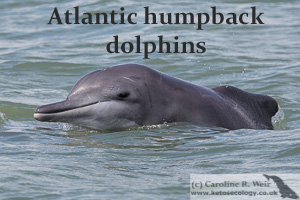
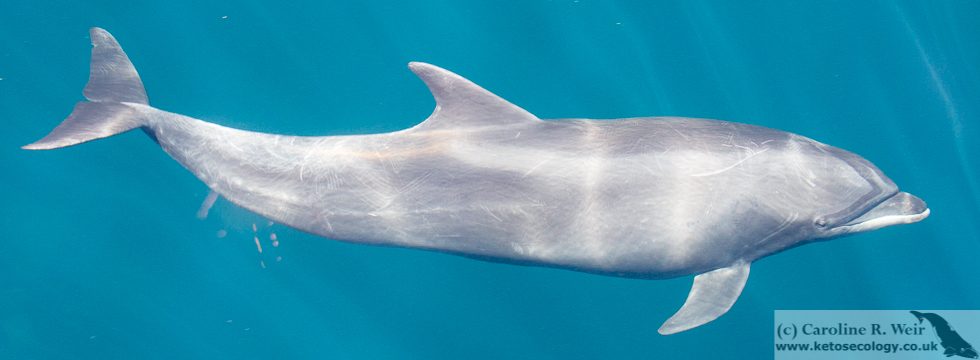
The Atlantic humpback dolphin (Sousa teuszii) is a
relatively small (c. 2.5 m) species endemic to the west coast of Africa in
the eastern Atlantic Ocean. The species is characterised by a robust
body, a diagnostic long, thick hump on the dorsal surface on which the small
dorsal fin is situated, and a long and slender beak.
The distribution and status of Atlantic humpback dolphins is
very poorly known. It is currently confirmed to occur in the coastal
waters of nine range states comprising Morocco, Mauritania, Senegal, The
Gambia, Guinea-Bissau, Guinea-Conakry, Cameroon, Gabon and Angola.
Evidence suggests that dolphin distribution is discontinuous within this
range, with sightings absent from some studied areas e.g. Ghana and Benin
(Van Waerebeek et al., 2004).
There are no data available regarding
population size in any of the known range states, though estimates from the
best-studied areas vary from as few as 28 animals in Dahkla Bay (Senegal) to
perhaps several hundred animals in Canal do Gęba-Bijagos (Guinea-Bissau)
(Van Waerebeek et al., 2004). Since this endemic species is both restricted
in geographic distribution and appears to be uncommon throughout most of its
existing range, the total worldwide population is likely to be low.
However, limited evidence suggests that by-catch in fishing nets and
deliberate hunting for meat are significant causes of mortality, and may
have caused local extinction in some areas (Van Waerebeek et al., 2004).
The International Union for Conservation of
Nature and Natural Resources (IUCN) currently classifies Atlantic humpback
dolphins as Data Deficient (though this classification is likely to change
to threatened), and they are included on the Convention on Migratory Species
(CMS)’s Appendix II (unfavourable conservation status), and the Convention
on International Trade in Endangered Species of Wild Flora and Fauna (CITES)
Appendix I (threatened).
Due to the general absence of research in the
West African region little is known of the behaviour, biology and ecology of
Atlantic humpback dolphins, although they are generally assumed to have
similar habits to the closely-related and comparatively well-studied
Indo-Pacific humpback dolphin (S. chinensis) which occurs in the
Indian Ocean, south-east Asia and northern Australia. This species inhabits
tropical and subtropical waters close to shore (usually <25 m water depth),
particularly within bays and estuaries and in association with rocky reefs.
On open coasts such as found along most of Angola’s coastline, humpback
dolphins are usually observed just seaward of the surf line. Limited
stomach content data indicate that Atlantic humpback dolphins have a
piscivorous diet, taking fish such as mullet. Humpback dolphins have been
recorded in groups of up to 37 animals in the Saloum Delta in Senegal, but
groups of 4 to 7 seem more typical in other West African regions. |
|
 |