|


| |
Ketos Ecology
carried out a short two-week survey off Angola during May 2007 to record cetaceans and marine turtles during a seismic survey.
Survey work commenced on 3rd May and
some of the diary highlights of the trip are provided here:
|
May
3rd - The first highlight of the trip is of the feathered
variety! I am just walking onto the bridge when a flash of
white outside the window alerts me to a visitor. A (very lost)
cattle egret has settled on the bridge railings and is balancing
there very precariously as the ship rolls in the swell, it's long
toes wrapped around the rail. Unfortunately the bridge is a
busy place, and the bird is nervous and quickly disturbed from its
resting place. We last see it flying off to the south, a
strange sight in the middle of the ocean. |
|
May
3rd - A couple of very large splashes up ahead of us are
the cue I have been waiting for. Through the binoculars I see
the small black shapes of leaping dolphins emerging several metres
above the sea and crashing back down again onto their sides.
As the animals draw slightly closer I see one do a full somersault
midair and many other acrobatic individuals are performing leaps and
turns with incredible agility. The dolphins are not interested
in our vessel, and keep a good distance away from the ship. I
suspect them to be striped dolphins from this typical energetic
behaviour, but they do not approach closely enough for positive
identification. |
|
May
7th - There is a strange tapping sound on the bridge window and
we look up to see we have a visitor! A woodland kingfisher is
perched on the window ledge looking in at us. The bird looks
fit and well, its turquoise plumage brightening up the ship
considerably. But it is a long way from its usual onshore
habitat of mangroves and woodlands, and we wish it luck finding it's
way home as it flies away.
|
|
May
7th - Low bushy blows ahead of the ship reveal the presence of
two sperm whales. One animal flukes a few minutes after I
detect them, but its companion remains at the surface for longer and
passes between the seismic vessel and the chase boat. This is
the closest sperm whale encounter I have had so far this trip, with
the adult whale logging at the surface within a kilometre of the
vessel. Shortly after passing our beam the whale produces a
bigger blow and rolls slightly at the surface indicating that it is
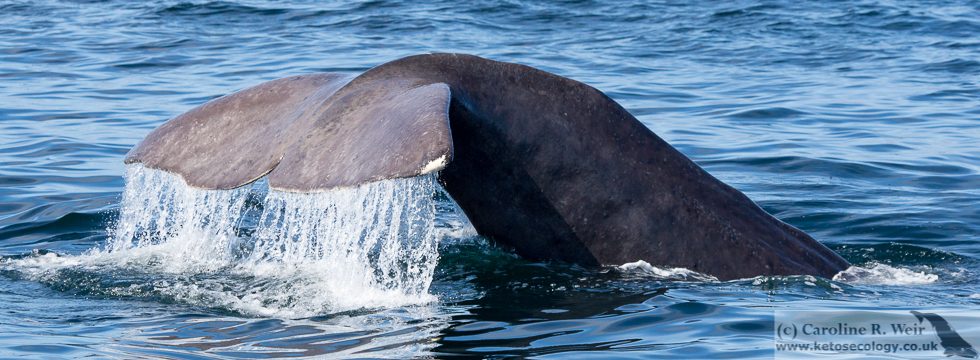
preparing for a dive. After its next and final blow, it arches
its back and tail stock and dives, lifting it's tail flukes high
into the air.
|
|
May
9th - I have been in the bridge filling in the form for a sperm
whale sighting, and almost miss the smaller fins passing 1.5 km
ahead of the ship. There are about 11 animals in total and
although small they do not behave like typical dolphins. In
fact I quickly note the rounded heads and tall, prominent dorsal
fins which are suggestive of Risso's dolphins.
Silhouetted against the sun the dolphins appear jet-black in colour and are rather robust in
appearance, travelling purposefully to the south-west in a tight
group. Although they are distant I take some images which are
later used to confirm the identification. |
|
May
11th - Suddenly standing out markedly against the bright blue
sea, is the tall slender white blow from a baleen whale. The
whale blows again, and has moved quite a distance under the water
since it's previous surfacing. The blow is clearly from a
rorqual whale, and does not appear bushy enough to belong to a
humpback which I am expecting to arrive back from Antarctica any day
now. I suspect this is a Bryde's whale, the most common of the
other possible species and the only type of baleen whale that
remains in Angolan waters during the summer months. The whale
emits a sequence of 12 blows, before it sounds on a deeper dive
revealing its tailstock and falcate dorsal fin. I observer
four more surfacing sequences, and manage to capture some photos of
the whale before it disappears from sight. The photos show
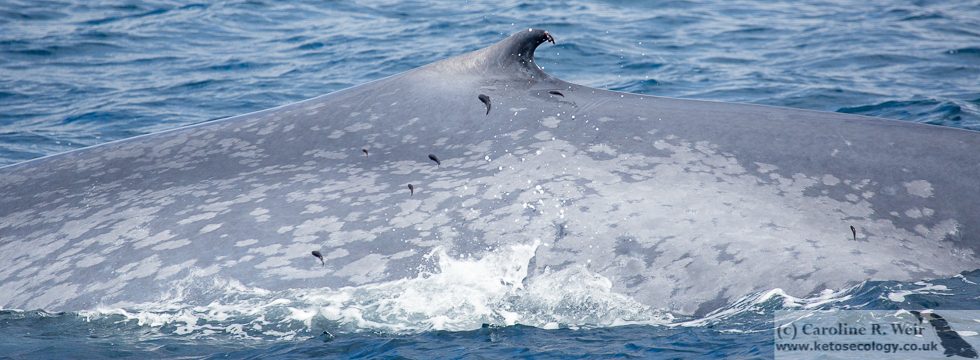
round scars on it's lower flanks, typical of cookie-cutter shark
bites. |
|
May
13th - Another cattle egret today. This one flies several
times around the ship before finally landing on one of the
spotlights on the helideck where it remains resting for several
hours. |
|
May
14th - For a brief second I spot dark blobs amongst the swell in
the ocean ahead of the ship. I start to imagine I am seeing
things, as it is several minutes before I relocate what turns out to
be pilot whales. The small group contains eight animals
including two large bulls, and it is probably the fins of the latter
two animals that caught my eye initially. The whales travel
purposefully across our bow a long way ahead of us, and disappear
off to the south. |
|
|
With
many thanks to the crews of the Ramform Vanguard and to Total E&P Angola
(Block 32).
Return
to the top of the page
Ketos
Ecology ©
2007
|