January 2008

Back
Sousa teuszii
Background
Project methods
Study area
January 2008
June/July 2008
Photo gallery


Results of the January 2008 survey


BOAT-BASED SURVEYS


Twenty-eight boat-based surveys for Atlantic humpback dolphins were carried out between 11 and 30 January 2008.  Most survey effort occurred within 1 km of the coast where humpback dolphin encounters should be maximised.  The majority of survey effort occurred north of Flamingos, with fewer trips carried out south towards Tombwa.  The routes covered by boat extended approximately 25 km to the north and south of Flamingos respectively, therefore covering a total study area of around 50 km coastline.  A total of 120 hr and 1,218 km of survey coverage was achieved during boat-based surveys. 


SHORE-BASED SURVEYS


Twenty-four shore-based watches were carried out from Flamingo Lodge in the centre of the study area.  A total of 33.7 hr survey effort was collected during shore-based surveys. 


CETACEAN SIGHTINGS


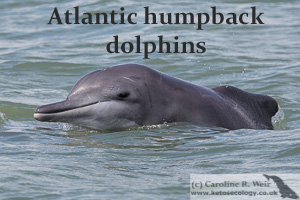
There was a total of 96 sightings and a minimum of 324 individual cetaceans recorded off Flamingos between 11 and 30 January 2008.  This included at least two dolphin species and two baleen whale species (Table 1).  Atlantic humpback dolphins were the most frequently recorded species, although Bryde’s whale was also common within the study region. 


Table 1. Summary of cetacean sightings recorded off Flamingos during January 2008

Species

No of sightings

No. of animals

Atlantic humpback dolphin

48

144

Bottlenose dolphin

5

10

Unidentified dolphin sp.

3

120

Bryde’s whale

37

45

Humpback whale

1

2

Unidentified whale sp.

2

3


Of the 48 Atlantic humpback dolphin sightings recorded during the survey, 32 occurred on-effort during boat-based surveys, seven were recorded during dedicated shore-based surveys, and nine were observed opportunistically.


DISTRIBUTION AND HABITAT PREFERENCES OF HUMPBACK DOLPHINS


Humpback dolphins were found throughout the northern and central portions of the study area, but were not sighted in the southernmost regions.  The southern limit of dolphin distribution appeared to be off a stretch of high sand cliffs at 15°38'S.  Dolphins were several times observed to travel as far south as these cliffs before turning northwards again.


Atlantic humpback dolphins off Flamingos exhibited similar habitat preferences to humpback dolphins found worldwide.  They were only once sighted further than 1 km offshore, when a single animal followed three bottlenose dolphins out to sea.  All of the remaining encounters occurred within 800 m of the coast, and usually within 300 m of the shore line. 


PHOTO-IDENTIFICATION


The photo-identification feasibility study of humpback dolphins in Namibe Province proved successful.  The animals proved to be distinctively well-marked, with all adult animals encountered within the region having nicks missing from the trailing edge of the fin.  The only animal that did not bear distinctive dorsal fin markings was a calf.


A total of nine individual Atlantic humpback dolphins were identified off Flamingos, on between five and 15 occasions each (sometimes more than once on the same day).  The photo-identification catalogue of humpback dolphins identified off Angola (and updated following the winter survey) can be downloaded HERE.


BEHAVIOUR


A total of 25.9 hr of focal follow data were collected during boat- and shore-based surveys.  The majority of Atlantic humpback dolphin time was spent either travelling along the coast or opportunistic foraging.  A small amount of time was spent in active feeding behaviour, when the chasing and capture of fish was seen. 


Several hours of acoustic recordings were made during encounters with Atlantic humpback dolphins, with whistles, click trains and limited burst-pulse sounds recorded.


Ketos Ecology © 2008


Return to the top of the page