|


| |
A
high diversity of dolphins are found off Angola. Two species endemic to
West Africa, the
Atlantic humpback dolphin (Sousa teuszii) and
Heaviside's dolphin (Cephalorhynchus heavisidii) occur strictly in
coastal waters and have not been recorded during the pelagic survey work.
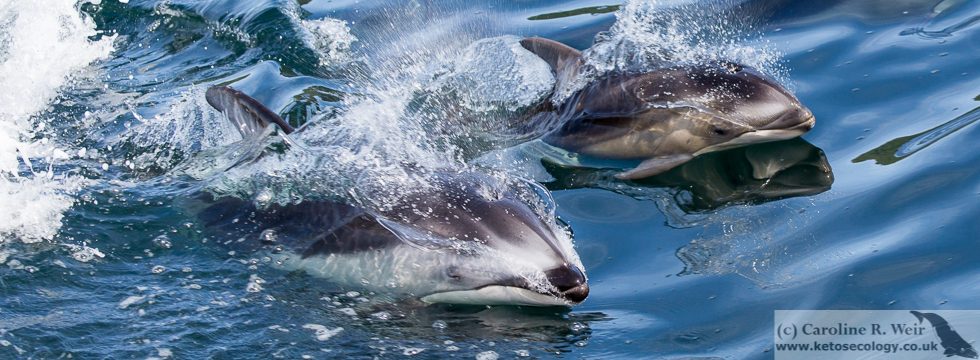
We have to date recorded ten species of 'true' oceanic dolphin and a further
five species of 'blackfish' (larger dolphins commonly referred to as 'whales'). The majority of dolphins cannot be identified to species
level, due to the fact that they are most often seen several
kilometres from the survey vessel, and because of the similarity of many tropical dolphin species to one
another (particularly the seven dolphin species comprising the Genus Stenella
and Delphinus). Brief species accounts are provided
below.
|
'True'
dolphins |
|
Atlantic spotted
dolphins (Stenella frontalis)
are the most frequently
identified dolphin species during offshore survey work off Angola
(with sightings also recorded during limited surveys off Gabon).
Most sightings of this species have involved animals that approached the
vessel to bow-ride, enabling a higher number of positive identifications than for other dolphin species. Group size of Atlantic spotted
dolphins off Angola and Gabon appears higher than in the western Atlantic Ocean, with
schools frequently consisting of several hundred animals.
Sightings
have been recorded over a wide range of water depths from 200 m to over
2,200
m, and this species therefore seems to primarily inhabit shelf edge
and oceanic habitat off Angola. Atlantic spotted dolphin sightings have occurred
throughout the year, and this species is probably a common
'resident' in Angolan waters.
|
|
Pantropical spotted dolphins
(Stenella attenuata), have been positively identified off both
Angola and Gabon, but are probably relatively more numerous off
Gabon. Positive sightings have consisted of between 3 and 70 animals, and occurred
over
a water depth range of 328-894 m, suggesting that this species
may favour upper shelf edge habitat off West Africa. It is
likely that identification problems have resulted in under-recording of
this species off Angola, and its exact status in the region remains unclear.
|
The Clymene dolphin (Stenella
clymene) has been positively identified twice during our survey work
off West Africa. A pod of 12 dolphins
were observed off Angola during March
2004 (amongst a large group of unidentified dolphins), and a sighting of
250 dolphins was recorded off Congo during September 2005. These
sightings have been incorporated into a scientific paper on this
poorly known species, which has been published in African Zoology (Download).
|
There
has been only one positive sighting of the long-snouted
spinner dolphin (Stenella longirostris) off Angola. However, there have been at least six further
sightings that were identified as either spinner or Clymene dolphins, and many of
the unidentified Stenella dolphins seen 'spinning' during aerial
behaviour are also likely to have comprised one of these two species.
Unfortunately the great distance of many of the sightings from the survey
vessel usually prevents conclusive identification of, and separation
between, these two very similar species. |
Striped
dolphins (Stenella coeruleoalba) have been recorded on at least
seven occasions off Angola, and apparently inhabit the region
throughout the year. They
have been sighted only in deep water of between
1,600 and 2,400
m seaward of the shelf edge. Group size of striped dolphins off
Angola is usually
between 8 and 50 animals, with one record of a larger group of 125
animals. We suspect that striped dolphins have
been under-recorded during the surveys, with many further dolphin
groups showing some characteristics of this species but remaining too
distant from the vessel for positive identification. On one occasion, striped dolphins
were observed in a mixed-species association with common
dolphins. |
|
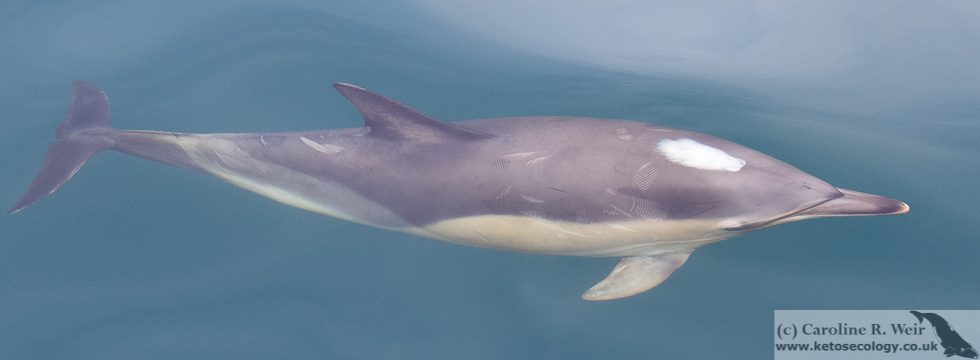
Both
species of common dolphin
(short-beaked
(D. delphis) and long-beaked (D. capensis)) occur
off Angola, with most sightings occurring too far from the
ship to accurately distinguish
between them and therefore being simply recorded as 'common dolphin
sp.'. Common dolphin sightings involved groups of between
1 and 400 dolphins (mean = 56). Sightings have been recorded over water depths ranging from 75 m to
2,300 m, and this is therefore one of the few cetacean species that inhabits
the entire depth range off Angola. Common dolphins appear to be one
of the most abundant cetacean species off Angola, but the relative status of the two species
within the area remains unclear. Further information on the
taxonomic status of Delphinus off Angola is available
here.
|
|
Rough-toothed
dolphins (Steno bredanensis)
have been recorded on four occasions off Angola and once off Gabon.
On three of these occasions the dolphins were observed in mixed species
assemblages, once with an unidentified small 'blackfish' species (possibly
melon-headed whales) and twice with short-finned pilot whales (one
sighting also including bottlenose dolphins). Rough-toothed dolphins are probably a regular
component of the Angolan cetacean fauna but are certainly not
numerous. The sightings to date have comprised small groups of 11 to
20 animals, and have occurred over deep-water shelf edge habitat of
between 400 and 2,100 m water depth.
|
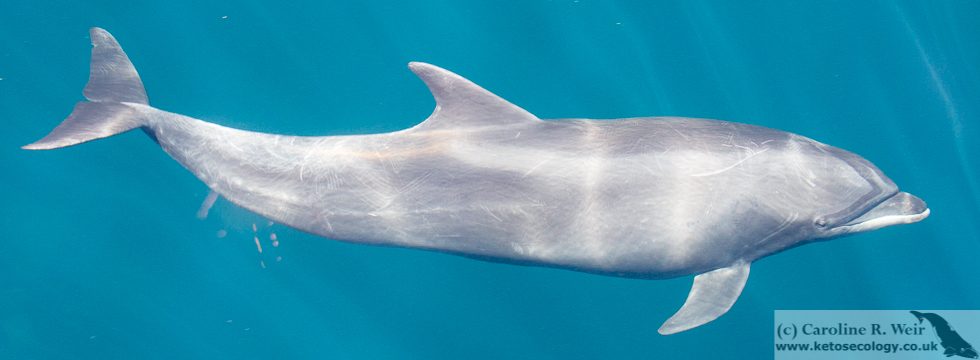
Bottlenose
dolphins (Tursiops truncatus)
have been recorded reasonably regularly off Angola, Congo and
Gabon, occurring over shallow
continental shelf waters (<200 m), over the shelf edge and also out in
very deep water of over 3,000 m. This species has been recorded in
the immediate vicinity of the coast in Luanda
Harbour and at Soyo in Angola, and off Port Gentil in Gabon. Bottlenose dolphin groups comprised between 1 and 50
animals, but with most groups consisting of 15 or fewer animals.
Many of the bottlenose dolphin sightings in deeper water involve
mixed-species schools in association with short-finned pilot whales.
|
Fraser's
dolphins (Lagenodelphis hosei)
has been positively identified only once
to date off Angola, when a group of 120 animals was recorded in 1,900 m
water depth. Based on it's geographic distribution elsewhere, this
species is expected to occur throughout tropical deep waters off West
Africa.
|
|
Risso's
dolphins
(Grampus griseus) have been sighted irregularly off Angola,
although the sightings tend to occur in clusters. Records
involve relatively small group sizes of between 4 and 25 animals, and
this species appears to be less abundant than many other dolphin
species in the region. The distribution data suggest that
Risso's dolphins may be relatively more numerous in 'blue water'
areas off Angola rather than in waters influenced by the freshwater
Congo outflow. Risso's
dolphins are
usually recorded over deep water exceeding 1,000 m water depth. However, a large group of dolphins containing at least 10 Risso’s dolphins was
observed over shelf waters (>200 m) off Gabon during April 2004. Records
of this species occur throughout the
year, suggesting that Risso's dolphins are a regular, though not
numerous, component of the Angolan cetacean fauna.
|
|
'Blackfish' |
|
The
term 'blackfish' is applied to six species of large dolphin, which
due to their size and appearance are commonly referred to as
whales. All six of these species potentially occur off Angola,
and five have been confirmed in the region to date.
|
|
The
survey
work has revealed that killer whales (Orcinus orca)
occur fairly regularly off Angola, with eight sightings between September 2004 and
December 2006. Killer whale pods have comprised between 4 and 10 animals,
and several of the sightings have included young calves. All of
the survey records were located over deep water of 969 to 2,600 m water depth.
Some opportunistic
records provided by observers along the Angolan coast also indicate that this
species occurs in shallow waters. During January 2005, killer whales were
observed in an apparent attempted predatory attack on a group of sperm
whales, images of which can be viewed
here.
|
Short-finned
pilot whales (Globicephela macrorhynchus) are the most
frequently recorded 'blackfish' species off Angola and inhaibt the
region year-round. Although unconfirmed, it is likely that the long-finned
pilot whale (G. melas) also occurs in southern Angola
where the sea temperature is influenced by the cold-water Benguela
Current. The relative distributions of these two species off
Angola remains uncertain, but most records in tropical northern
Angola are presumed to be short-finned pilot whales. In
December 2006 we were able to get some close-range images of
short-finned pilot whales which confirmed they show a uniform dark
pigmentation off Angola and lack the pale cape and eye stripe seen in
some populations. As in most
other parts of their range, pilot whales appear to inhabit exclusively
shelf edge and deep waters off West Africa, with recorded depths ranging from 402 to over
4,100 m, and this is the most common cetacean species recorded in very
deep water (>3,000 m). The data indicate that pilot whales
are probably most numerous in 'blue' water areas off Angola, and are
less common in the turbid water influenced by the Congo River
outflow. Recorded group size ranges from 3 to over
200 animals, but most groups comprise between 8 and 40
animals. Pilot whales are gregarious animals and are often observed off
Angola in mixed-species schools with dolphins, most frequently the bottlenose
dolphin.
|
|
False
killer whales (Pseudorca crassidens) are a relatively uncommon
inhabitant of Angolan waters. Sightings to date have peaked during the austral spring months, although the data are currently
too few to determine whether this is a genuine seasonal trend.
School size of most false killer whale sightings was relatively small at
between 2 and 20 animals, but an aggregation possibly containing as many
as 100 animals was
recorded in October 2004. False killer whales are a shelf-edge and deep-water species, with all sightings occurring at 1,500 to 2,600 m
depth.
|
|
There
have been three confirmed sightings of melon-headed
whales (Peponocephala electra), all involving large active
schools of between 100 and 300 animals. The sightings all occurred during the austral spring and summer, and over deep waters of
between 1,300 and 2,300 m. Several further sightings have involved
animals identified as either melon-headed whales or pygmy killer whales (Feresa attenuata),
such as a group of 15 small blackfish recorded in in November 2006
(photo).
|
Ketos
Ecology
©
2007
Return
to the top of the page
|