|


| |
|
Welcome
to
the
Aberdeenshire Cetacean Catalogue (ACC) |
|
Background to the project |
|
Dedicated boat- and land-based surveys to monitor bottlenose
dolphins and other cetaceans off Aberdeenshire began in April 1999, with the
establishment of the South Grampian regional group of the
Sea
Watch Foundation (SWF). Boat surveys were initially carried out on an
opportunistic basis, funded by paying volunteers and members of the public.
During 2000 and 2001 vessel-based surveys were funded by Shell U.K.
Exploration and Production, leading to initial photo-identification work and
the production of a baseline report on cetacean occurrence in the region (Weir
and Stockin, 2001). This initial work led to the Kerr McGee, Talisman
Energy (UK) Ltd and Total E&P UK Plc funded
Aberdeenshire
Dolphin Project (ADP) boat surveys between 2002 and 2005. A joint
venture between the University of Aberdeen and the Sea Watch Foundation, the
ADP aimed to study the abundance, distribution and behaviour of cetaceans
along the Aberdeenshire coastline and was carried out as a dedicated PhD
project (Canning, 2007). Since the final ADP-sponsored boat survey in
November 2005, vessel surveys have continued opportunistically during 2006
and into 2007 funded by a combination of paying volunteers and SWF grants.
Several scientific papers and conference proceedings have been published
from the survey work to date, some of which are available to download
here.
|
|
|
|
Cetaceans off Aberdeenshire |
|
The coastal waters off Aberdeenshire are regularly inhabited
by four species of cetacean; the harbour porpoise, bottlenose dolphin,
white-beaked dolphin and minke whale.
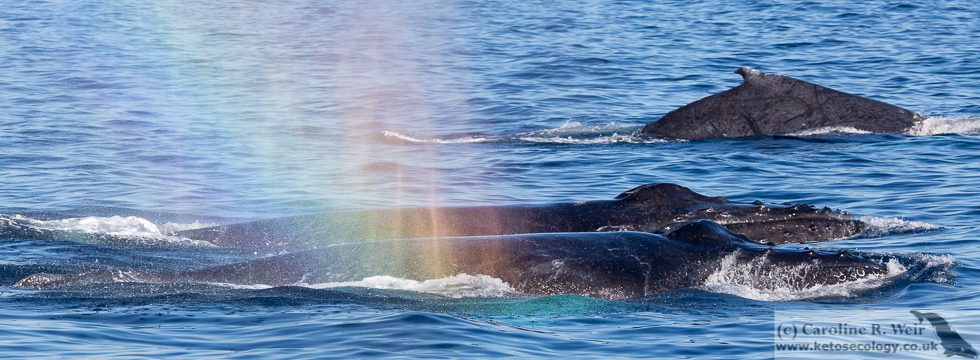
Other cetacean species recorded rarely in the region include humpback whale,
fin whale, sperm whale, killer whale, pilot whale, Risso's dolphin, Atlantic
white-sided dolphin and common dolphin.
|
|
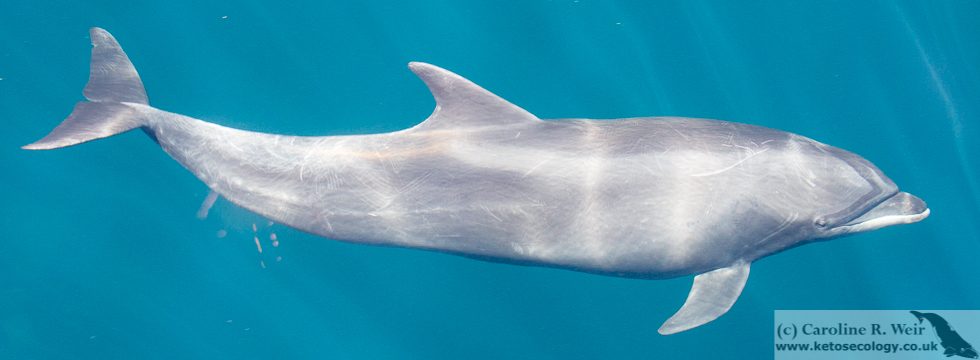
Bottlenose dolphin (Tursiops
truncatus)

Bottlenose dolphins are the most frequently reported
cetacean in the coastal waters off Aberdeenshire, and their
occurrence appears to have increased since the early 1990s.
While sighted throughout the year, bottlenose dolphins show peak
occurrence during the winter and spring months, particularly between
March and May. During this period bottlenose dolphins can be observed almost daily in
the mouth of
Aberdeen Harbour, where they spend many hours foraging and feeding
on salmonids between the breakwaters. Photo-identification (see
below) of individual animals has shown that the bottlenose dolphins
off Aberdeen belong to the 'Moray Firth population', estimated at
approximately 130 animals.
|
|
White-beaked dolphin (Lagenorhynchus
albirostis)

The
white-beaked dolphin is a summer visitor to Aberdeenshire waters,
occurring primarily between June and September. This is
considered to be the most numerous dolphin species in North Sea
waters, although its biology and ecology are not well understood.
White-beaked dolphins occur predominantly in pelagic waters, and
they appear to move into Aberdeenshire coastal waters seasonally.
Groups range from three or four individuals to aggregations
exceeding 30 animals, and often include calves and juveniles.
White-beaked dolphins are easily distinguished from bottlenose
dolphins by the white blaze along their flanks, white beak and white
'saddle' patch behind the dorsal fin.
|
|
Minke whale (Balaenoptera
acutorostrata)

Minke
whales are the only baleen whale species to commonly occur within
North Sea waters. This species can be seen from headlands along the
Aberdeenshire coast, and has even been recorded from sandy beaches
such as Aberdeen and Balmedie. Minke whales are usually
recorded as single animals. Numbers appear to peak in July and
August, however whales have been recorded off Aberdeenshire at most
times of year including the winter months.
|
|
Harbour porpoise (Phocoena
phocoena)

The
harbour porpoise is the smallest cetacean occurring off
Aberdeenshire, reaching around 1.5 m length. It occurs in the
region throughout the year, though peak numbers are recorded in the
summer between June and September. Porpoises are typically
recorded in groups of 1 to 5 animals, although aggregations of 20 or
more animals may occur when feeding conditions are favourable.
This species may be seen anywhere along the coast, including
Aberdeen Harbour mouth.
|
|
|
Photo-identification as a research
tool |
|
The study of bottlenose dolphins and many other cetacean
species worldwide relies predominantly on photo-identification methods,
where individual animals are photographed and then later identified from
their unique markings. This process can used to catalogue the
movements of individual animals over space and time using a mark-recapture
principle, producing information on dolphin distribution and seasonal
movements, population size, site fidelity, social ecology, survival rates,
and reproductive parameters such as calving intervals and length of calf
dependency. The features
used to uniquely identify bottlenose dolphins are primarily the size and
location of notches and cuts in the trailing edges of the dorsal fin, but
also less permanent features such as body scarring and pigmentation.
For example, dolphin ABZ 5 (known as 'Sooty') is one of the most frequent
individuals to be recorded during boat surveys off Aberdeenshire, having a
particularly distinctive notch on the dorsal fin:
|

ABZ 5
recorded on 2 June 2006 |
|

ABZ 5
photographed again on 13 December 2009 |
Photo-identification of bottlenose
dolphins in Aberdeenshire waters has been carried out opportunistically since 2000/01, with
preliminary matches of several very distinctive animals confirming that at
least some of the animals are known individuals from the Moray Firth
population. Photographing individuals over time provides an indication
of how frequently particular animals are using Aberdeenshire waters, which
has implications for their conservation and management.
|
|
The Aberdeenshire Cetacean
Catalogue (ACC) |
|
The Aberdeenshire Cetacean Catalogue (ACC) was created to compile
all images taken of bottlenose dolphins and other cetacean species off
Aberdeenshire, in order to determine annual and seasonal use of the region
by particular animals, and to establish the extent of the link with bottlenose
dolphins in the Moray Firth. Version 1 of the ACC aimed to catalogue
existing images taken off the Aberdeenshire
coast between 1999 and 2006, with particular focus on bottlenose dolphins.
This served as a baseline for future more comprehensive survey work.
Production of the
ACC would not have been possible without the aid of several collaborators
who have photographed bottlenose dolphins off Aberdeen over the 1999-2006
period, predominantly comprising Sarah Canning, Kevin Hepworth, Keith
Ringland, Karen Stockin and Caroline Weir. Grants and support of the
1999-2006 boat surveys were variously provided by the general public, Sea
Watch Foundation, Aberdeen University, Shell U.K. Exploration and
Production, Kerr McGee, Talisman Energy (UK) Ltd and Total E&P UK Plc.
Production of Version 1 of the ACC was kindly supported by AMEC.
|
Return
to the top of the page
|