WBD in Scotland

Back
WBD Fact File
WBD Identification
WBD in Scotland
WBDP study 2007
Contact us


The following information summarises what is known about white-beaked dolphins within Scottish waters:


Distribution in Scottish waters

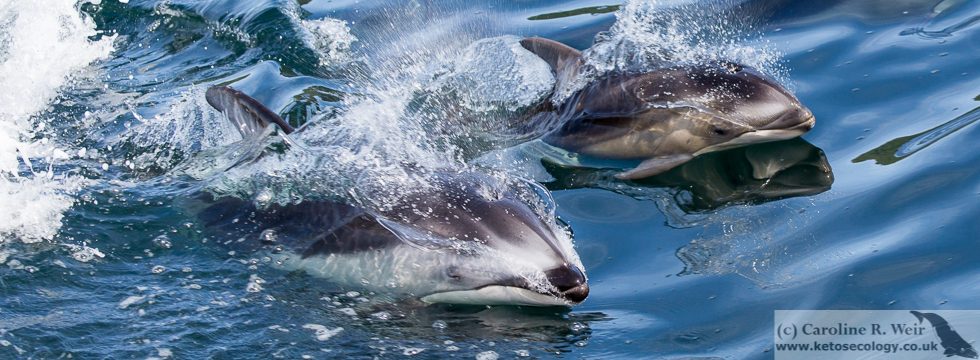
The white-beaked dolphin (Lagenorhynchus albirostris Gray, 1846) is the most frequently sighted dolphin species in Scottish waters (Evans, 1992; Weir et al., 2001), which seemingly comprise a significant portion of the entire worldwide range of the species.  Within Scotland white-beaked dolphins primarily inhabit the North Sea and continental shelf waters (<200 m depth) off north-west Scotland (Northridge et al., 1997; Weir et al., 2001; Reid et al., 2003).  The main concentrations around Scottish waters occur in the northern Minch and around the Western Isles (Reid et al., 2003), and in a strip along the western side of the North Sea from the Orkney Islands south to Yorkshire (Northidge et al., 1995). 


Abundance

The SCANS survey of 1994 produced an estimated abundance of 7,856 white-beaked dolphins for the combined North Sea, northern Minch, Northern Isles and Channel (Hammond et al., 1995, 2002), which appears to be the only calculated abundance estimate available for the species worldwide.  


Distribution of white-beaked dolphins around Scotland (from Reid et al., 2003)

Biology and Ecology

Very little is known about the biology and ecology of white-beaked dolphins off Scotland.  Water depth appears to be a primary factor governing their occurrence off the west coast of Scotland, with most sightings occurring in depths less than 122 m (Macleod et al., 2007).  Although they are thought to be resident year-round in much of their Scottish range, they appear to show an inshore movement into coastal waters during the summer months off Aberdeen (Weir et al., 2007).  Strandings of white-beaked dolphins are uncommon, with only several animals per year.  Analysis of stomach contents has shown that white-beaked dolphins stranded in Scotland had fed primarily on fish (especially whiting), and also octopus (Santos et al., 1994).  White-beaked dolphins off Scotland typically occur in groups of 3 to 5 animals.  Calving is thought to occur primarily between May and September.


Threats in Scottish waters

Despite being widely cited as the most numerous dolphin species in the North Sea, practically nothing is known of the ecology, biology, life history, abundance and threats to white-beaked dolphins in Scottish waters.  However, there are a number of potential concerns.  White-beaked dolphins are frequently seen in similar areas to fishing vessels, and there is a known bycatch of this species in fishing gear in many areas.  The scale of this issue in UK waters is unclear, and bycatch take limits for white-beaked dolphins in Scottish waters cannot be allocated until the abundance and vulnerability of dolphins in this region is clarified (Northridge and Thomas, 2003).  Other potential threats to white-beaked dolphins in Scottish waters include pollution (Andersen and Rebsdorff, 1976), habitat loss due to climate change (Macleod et al., 2005) and acoustic disturbance from shipping, military and seismic survey vessels (Evans, 1996).  White-beaked dolphins are the most frequently reported dolphin during seismic surveys in the North Sea (Barton, 2003), and establishing the effects of airgun activity on their behaviour and distribution is not possible without having baseline data collected during undisturbed conditions. 


References

Andersen, S.H. and Rebsdorff, A. (1976).  Polychlorinated hydrocarbons and heavy metals in harbour porpoise (Phocoena phocoena) and whitebeaked dolphin (Lagenorhynchus albirostris) from Danish waters.  Aquatic Mammals, 4: 14-20.

Barton, C.J.S. (2003).  The effects of seismic activity on marine mammals in UK waters, 1998-2000.  Report No. 323, Joint Nature Conservation Committee, Aberdeen.

Evans, P.G.H. (1992).  Status review of cetaceans in British and Irish waters.  UK Mammal Society Cetacean Group Report, University of Oxford, 100pp.

Evans, P.G.H. (1996). Human disturbance of cetaceans. In: The Exploitation of Mammals –principals and problems underlying their sustainable use, ed. by. N. Dunstone and V. Taylor, pp. 374-394.  Cambridge University Press.

Hammond, P.S., Benke, H., Berggren, P., Borchers, D.L., Buckland, S.T., Collet, A., Heide-Jørgensen, M.P., Heimlich-Boran, S., Hiby, A.R., Leopold, M.F. and Øien, N. (1995).  Distribution and abundance of the harbour porpoise and other small cetaceans in the North Sea and adjacent waters.  Final report Life 92-2/UK/027.

Hammond, P.S., Berggren, P., Benke, H., Borchers, D.L., Buckland, S.T., Collet, A., Heide-Jørgensen, M.P., Heimlich, S., Hiby, A.R., Leopold, M.F. and Øien, N. (2002).  Abundance of harbour porpoise and other cetaceans in the North Sea and adjacent waters.  Journal of Applied Ecology, 39: 361-376.

MacLeod, C.D., Bannon, S.M., Pierce, G., Schweder, C., Learmonth, J.A., Reid,R.J. and Herman, J.S.  (2005).  Climate Change and the Cetacean Community of North-West Scotland.  Biological Conservation, 124: 477-483.

Northridge, S. and Thomas, L. (2003).  Monitoring levels required in European Fisheries to assess cetacean bycatch, with particular reference to UK fisheries.  Report to DEFRA. 

Northridge, S.P., Tasker, M.L., Webb, A. and Williams, J.M. (1995).  Distribution and relative abundance of harbour porpoises (Phocoena phocoena L.), white-beaked dolphins (Lagenorhynchus albirostris Gray), and minke whales (Balaenoptera acutorostrata Lacepède) around the British Isles.  ICES Journal of Marine Science, 52: 55-66.

Northridge, S., Tasker, M., Webb, A., Camphuysen, K. and Leopold, M. (1997).  White-beaked Lagenorhynchus albirostris and Atlantic white-sided dolphin L. acutus distributions in Northwest European and US North Atlantic waters.  Report of the International Whaling Commission 47, 797-805.

Reid, J.C., Evans, P.G.H. and Northridge, S.P. (2003).  Atlas of cetacean distribution in Northwest European waters.  Joint Nature Conservation Committee, Peterborough, UK.

Weir, C.R., Pollock, C., Cronin, C. and Taylor, S. (2001).  Cetaceans of the Atlantic Frontier, north and west of Scotland.  Continental Shelf Research, 21: 1047-1071.

Weir, C.R., Stockin, K.A. and Pierce, G.J.  (2007).  Spatial and temporal trends in the distribution of harbour porpoises, white-beaked dolphins and minke whales off Aberdeenshire (UK), north-western North Sea.  Journal of the Marine Biological Association of the UK, 87: 327-338.


© WBDP 2007


Return to the top of the page