|


| |
Five cetacean species
were positively identified during the August 2007 survey in the Minch. The
following species accounts contain the summarised results on distribution,
relative abundance, group size and composition, photo-identification and
behaviour for each species. Please select from the species links below:
White-beaked dolphin
|
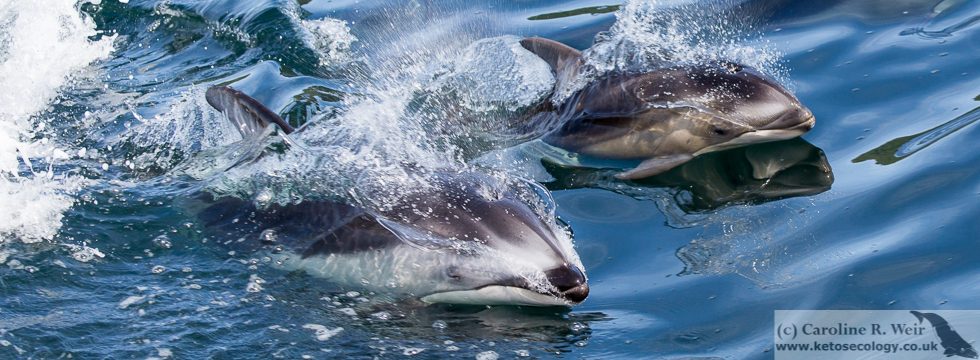
There were a total of 10 sightings of white-beaked
dolphins during the survey, comprising a minimum estimate of 70 animals.
The sightings were restricted to the northern part of the Minch between
the Butt of Lewis and Kinlochbervie, and were
limited to only two ¼ ICES rectangles. However, the relative abundance
of white-beaked dolphins within those areas was high. Although
adverse weather conditions during August did limit the extent of the
survey coverage, the survey was successful in locating an area of
white-beaked dolphin concentration in the northern part of the Minch, in
a similar region to where white-beaked dolphin abundance was high during
the 1980s and 1990s. The distance from shore of the sightings
ranged from 22 to 32 km with a mean of 26 km. This area is
approximately mid-way across the Minch, indicating that white-beaked
dolphins showed a strong preference for open habitat located outside of
the immediate coastal zone. The water depth for white-beaked
dolphin sightings ranged from 107 to 135 m with a mean of 122.5 m,
reflecting the pelagic distribution of this species. The number of
dolphins recorded differed significantly between water depth categories,
with more animals than expected occurring in the ≥100 m depth category.
White-beaked dolphins were recorded in a rather narrow water temperature
range varying between 13.2 and 13.5°C, with a mean of 13.4°C. More
animals than expected were observed in the 13.0–13.9°C water temperature
category.
The group size of white-beaked dolphins ranged from two to 12
animals, with a mean of 7.0 animals. The proportion of calves identified
within five groups varied from 25 to 50%, indicating that some
white-beaked dolphin pods in the Minch consisted entirely of mother-calf
pairs. Only three individuals were photo-identified from permanent
markings on the dorsal fin, with a further five individuals tentatively
identified from temporary markings (N=2) and/or permanent features (N=3)
that were visible (but ill-defined) in poor-quality images.
Vocalisations by this species were generally sparse, comprising sporadic
whistles and some short click trains. Opportunistic broadband recordings
showed that white-beaked dolphin whistle harmonics were visible at
frequencies up to 35 kHz, while the broadband clicks contained high
energy levels up to around 160 kHz.
|
|

Location
of white-beaked dolphin sightings |
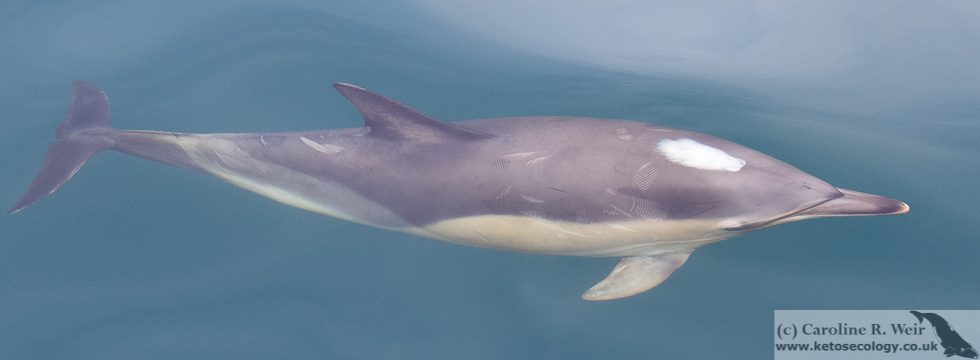
Short-beaked common dolphin
|
There were
a total of 11 sightings of short-beaked common dolphins during the
survey, comprising a minimum estimate of 1,486 animals. Common
dolphins were the most numerous cetacean species recorded in the Minch,
and sightings were widely distributed across the survey area. The
widespread occurrence of common
dolphins recorded during the survey in the Minch during August 2007 was
notably different from surveys carried out in the 1980s and 1990s, and
indicative of a marked increase in the occurrence of this species off
the west coast of Scotland. The distance from shore of common
dolphin sightings ranged from 1 to 28 km, with a mean of 13 km.
The water depth of common dolphin sightings ranged from 70 to 240 m with
a mean of 116.3 m, and significantly more animals than expected were
observed in depths greater than 50 m. Sea water temperature at the
location of common dolphin sightings varied from 12.0 to 14.2°C with a
mean of 13.5°C, and common dolphins showed a significantly higher
occurrence in temperatures <14°C indicating a preference for cooler
waters.
The recorded group size during common
dolphin sightings was high, ranging from 3 to 450 with a mean of 135.1
animals. A total of 24 common dolphins were photo-identified from
permanent markings on the dorsal fin. A further 18 individuals were
tentatively identified from large temporary markings (N=11) and/or
permanent features (N=7) that were visible (but ill-defined) in
poor-quality images. Most common dolphins bore numerous tooth rakes and
small scars, and these were not considered suitable for long-term
photo-identification. Many individuals had ‘clean’ fins that lacked
nicks or notches. Acoustic recordings were made during five common
dolphin encounters, and this species was often detected acoustically
long before visual sightings were recorded. All common dolphin
recordings contained almost continual tonal calls, although the quality
of these varied from faint whistles to very loud whistles when animals
were close to the boat. Loud click trains and burst-pulse sounds were
also recorded, as dolphins investigated the hydrophone.
Opportunistic
broadband recordings made during the survey showed that common dolphins
whistles included harmonics whose frequency range extended to at least
40 kHz and their click trains contained significant energy at
frequencies as high as 140 kHz. |
|

Location
of common dolphin sightings |
Risso's dolphin
|
There were a total of
three sightings of Risso’s dolphins during the survey, comprising a
minimum estimate of six animals.
The sightings were located off the Eye
Peninsula, off Cape Wrath and in the centre of the Minch. The sightings
of this species were fewer than expected, since Risso’s dolphins are
known to inhabit the waters around the Eye Peninsula and Lewis on a
regular basis.
The distance from shore of the three Risso’s dolphin
sightings ranged from 0.8 to 26 km, with a mean of 11 km. The
water depth of the sightings ranged from 31 to 111 m with a mean of 62.7
m, and the water temperature at the location of the sightings varied
from 12.4 to 13.2°C, with a mean of 12.9°C.
The recorded group
size of Risso’s dolphin sightings ranged from 1 to 3, with a mean of 2.0
animals. Risso’s dolphin behaviour was generally elusive with the
animals surfacing unpredictably and infrequently, and moving large
distances while subsurface. Consequently, it did not prove possible to
approach and stay with this species for the purposes of
photo-identification. |
|

Location
of Risso's dolphin sightings |
Harbour porpoise
|
There were a total of
121 sightings of harbour porpoises during the survey, comprising a
minimum estimate of 246 animals. This was the most frequently sighted
cetacean species in the Minch during August 2007. Porpoise
distribution was widespread, with sightings occurring throughout the
surveyed area. The relative abundance of harbour porpoises was
highest to the west of Lochinver, and the waters west of Skye and around
Raasay also held high concentrations of porpoises. The distance
from shore of harbour porpoise sightings ranged from 0.6 to 24 km with a
mean of 6 km. This species was therefore found in a variety of habitat
types from the immediate coastal zone to open waters in the centre of
the Minch. The water depth of the sightings ranged from 23 to 262
m with a mean of 104.8 m. The sea water temperature at the
location of porpoise sightings varied from 12.1 to 14.6°C, with a mean
of 13.6°C. Harbour porpoise group size ranged from 1 to 12, with a
mean of 2.0 animals. The majority of sightings comprised singles (41%)
or pairs (37%) of animals. Eighteen percent of the sightings
included a calf, which is consistent with the May to July calving period
documented for British waters. |
|

Location
of harbour porpoise sightings |
Minke whale
|
There were a total of 10 minke whale sightings during the
survey, comprising a minimum estimate of 11 animals. Sightings of
minke whales were widespread in the Minch, with five animals being
observed in a relatively small area during transits around Raasay and
west of Skye. The distance from shore of minke whale sightings
ranged from 1 to 23 km with a mean of 10 km. This species therefore
occupies a variety of habitat types within the Minch including coastal
and open water areas. The water depth of the sightings ranged from 32
to 259 m with a mean of 100.3 m, and the water temperature at the
location of the sightings varied from 12.4 to 14.0°C with a mean of
13.3°C. No particular habitat preferences were therefore apparent for
minke whales. Of the ten recorded minke whale sightings, nine involved
single animals and there was a single observation of a pair of whales. |
|

Location
of minke whale sightings |
Other marine fauna
|
A wide range of other
marine species occur in the Minch, and these were recorded whenever they
were observed. There were a total of 15 sightings of seals during
the survey, comprising three common seals and 12 grey seals. Many
additional adult grey seals were also observed in the fishing harbours
of Stornoway and Kinlochbervie. Seal sightings were widespread,
although most occurred in waters adjacent to the coast. A large
basking shark was observed swimming slowly at the surface on 2 August, 1
km west of the mainland to the north of Kebock Head on Lewis. A well
decomposed dead basking shark was recorded between Skye and the west
coast mainland on 11 August. An ocean sunfish was observed on 9 August,
halfway between the Eye Peninsula and the Point of Stoer. |

© WBDP 2007
Return to the top of the page |