|


| |
|
This page describes highlights of some of the cetacean encounters
experienced during the 2008 field season |
|
Please
also visit our field note archives from 2003 to 2007 by
clicking on the links below:
|
|
30 August
2008: Offshore Angola, seismic survey
vessel
09:40 GMT
"After
returning to the bridge following a coffee break, the first thing I
notice is a long line of splashes off our port bow. The splashes
look strange...the white water contrasts sharply against the dark grey
background of the overcast grey skies and sea and are framed by the
ominous outline of the flaring offshore installation we are passing.
I pick up my binoculars to scan the area of disturbed water, and the
forms of travelling dolphins are clearly visible. The scene is odd
though...I have never seen dolphins moving in such a manner to produce
so much choppy water and yet reveal so little of themselves. The
bridge crew are also confused...'what are those, tuna?' they ask.
They look doubtful about my dolphin explanation until they also pick up
binoculars and see for themselves. I have long learnt from
experience that the best way to tackle these unusual sightings off West
Africa is to take photographs. Tempting though it is to stare
through binoculars to try and establish what species I am looking at,
the fast speed and splashy nature of the animals makes it very difficult
to get a good view. In contract, the still frames captured using
digital camera equipment can be enlarged to provide a much better (and
verified) clue as to the species present.
I grab my camera and move out onto the bridge wing where I fire off around
50 images as the dolphin school passes our bow and heads off into the
distance. Staring through the viewfinder, I concentrate on keeping the
camera as steady as possible and focusing on the narrow band of splashes
moving through the water. So it's not until I play back the images
afterwards that I am finally able to identify what I have seen. Most
of the images are useless, but nestled in between are several shots showing
the tiny triangular dorsal fins and short beaks of Fraser's dolphins.
This is a great record...there is only one previously documented sighting
for Angola (which we photographed last year) and no other at-sea records for
the entire Gulf of Guinea region except for a single probable record off
Nigeria in 2004. Unsurprisingly, the bridge crew have never heard of a
Fraser's dolphin, so I spend a few minutes showing them a picture in the
identification guide and explaining the importance of the sighting".
|
|
5 August
2008: Stonehaven, Scotland, research
boat
10:43 GMT
"The
sea is mirror calm today...a sufficiently rare event in the North Sea
that we decide to be brave and take our small boat directly east of
Stonehaven and out into open water. Although we usually
concentrate on the coastal region to try and maximise encounters with
bottlenose dolphins, today our quarry is a different species. For
at this time of year (Jul-Sep) the inshore waters along the east coast
of Scotland are inhabited by white-beaked dolphins.
We have progressed almost 12 miles out to sea and are about to turn back and
start the return leg home, when a small flock of circling gannets catches my
eye. So far today we have glimpsed several porpoises foraging under
gannets, but the animal that surfaces beneath this flock is considerably
bigger and faster. The size, behaviour and tall falcate dorsal fin
leave little doubt as to the identification, and I happily shout
'white-beaks!' to my colleagues as we turn and head over to the dolphins.
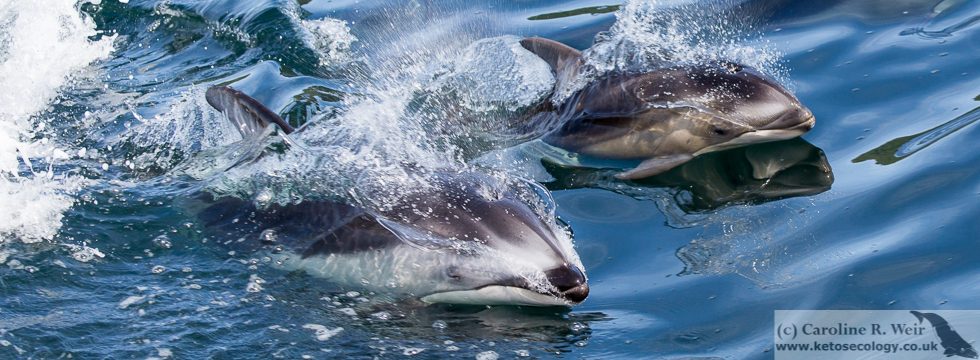
This is one of my favourite cetacean species...their panda-like black and
white colouration, together with their eagerness to bow-ride makes them a
great species to observe at sea. These dolphins inevitably approach
our boat to bow-ride briefly, and when we stop the boat and drift for
several minutes the dolphins swim round and underneath us, seemingly very
interested in our presence. Quickly however, they return to their
feeding and we start the trip back towards port.
Although we had seen no dolphins on the outbound transect, the return trip
towards the coast produces group after group of white-beaked dolphins.
In the glassy sea we can easily see their tall dorsal fins ahead of us and
off to both sides as small pods of 3 to 10 animals are scattered throughout
the region. We visit several more groups and all of them come to
bow-ride for short spells, before quickly losing interest as is typical for
this species. Several of the schools contain tiny calves, no doubt
born earlier this summer. Some mothers bring their calves to swim
alongside our boat, but most of them wisely keep some distance away.
By the time we have left the last of our white-beaked dolphin groups about
six miles east of Stonehaven, we have counted over 60 dolphins. And
this must be quite an under-estimate, given the scattered nature of the
animals and our pre-occupation with trying to photo-identify the closest
ones. It has been an exciting and memorable day on the water, and we
return home happy".
|
|
20 June
2008: Flamingos, Namibe Province, Angola, research trip
07:10 GMT
"We have been driving along the coast for
around 35 min when we spot the distinctive humped appearance of an Atlantic
humpback dolphin breaking the surface in the calm water. As we wait
for the animal to re-appear, more dorsal fins emerge and roll slowly at the
surface. I'm thrilled to have found them again, as this is the
first sighting of the species I have had since returning to Flamingos to
resume the humpback dolphin research I started in January. And I can't
wait to get a closer look at the individual dolphins and establish whether
this is the same group that I encountered consistently during the January
survey. We drive along the coast and position ourselves ahead of the
travelling dolphin group, and I walk down the beach with my camera.
The animals travel in a line, one behind the other, and only about 15 m from
the beach. As the first dolphin approaches I prepare to try and take a
photograph of its small dorsal fin, so that I can try and match the pattern
of nicks in the trailing edge with the animals I photographed in January.
The sharp exhalation of the dolphin's breath sounds, and I focus on the
dorsal fin and take the image. I don't even need to wait to analyse
the picture...the fin markings were clearly visible to my naked eye and I
immediately identify this animal as 'VW' one of the well-marked mature
adults I photographed in January (a catalogue of the individual dolphins can
be found
here). Back then,
VW's pod contained six dolphins including one large calf, one juvenile and
four adults. Now I am keen to establish whether this is still the case
or whether the group's composition has changed. I quickly identify
'Nicky' and her calf 'Junior', and 'Sooty' another adult. I am
surprised to see a further adult 'Chopper' is also with the group...this
animal was nomadic in January and only seen with the core study group on two
occasions. I am so busy concentrating on Chopper that I almost miss
the final three animals travelling alongside him. To my delight,
alongside one of the smaller adults is a tiny new calf!
The dorsal fin of the calf is poorly
developed and flopped over to the left hand side, strongly suggesting it has
been born fairly recently. The calf belongs to 'Flo', one of the
smaller adults in the core group. And the final animal is 'Nemo', a
poorly-marked juvenile whose identification I confirm later from analysing
the photographs. So my original study group of six animals has become
eight, with the addition of Chopper and the new calf. We track the
dolphin group from shore for over 7 hours, marking their position with a
GPS, noting their behaviour and the spatial group configuration, and taking
further photo-identification images whenever possible. The data
will later be analysed to examine their behaviour and habitat use in the
region, with the aim of developing a management plan to conserve this rare
and poorly-known species".
Please
visit our
Angola humpback dolphin
research
pages for more details and images from the field research carried out off Namibe Province in
Angola during June and July 2008.
|
|
10
May
2008: Aberdeen, Scotland, research
boat
13:45 GMT
"We have been surveying for only
15 min when splashes ahead of us indicate the presence of a dolphin
group not far from Stonehaven. The dolphins are feeding, emerging
from the water in high-speed forward leaps as they pursue fish.
The group of eight animals are spread out, and the first two dolphins to
approach the boat turn out to be Carter and Sooty, two of the most
regular animals that use our study area. Both remain tightly
associated, surfacing together and confidently interacting with our
research boat. I am keen to try and get photographs of all of the
other dolphins in the group, since the sea surface conditions today are
ideal. Our skipper carefully
manoeuvres the boat
to approach an individual dolphin which turns out to be Shrek, an animal
we have not identified here since 2004. An hour into the
encounter, and the dolphins turn northwards back towards Aberdeen.
Clearly in a leisurely mood, the animals repeatedly swim alongside and
underneath our boat, rolling on their sides to peer up at the hull.
In the glassy sea conditions we can see the entire group swimming
subsurface next to us, making photo-identification an unusually easy
task. Three dolphins suddenly begin to interact together, chasing
one another and repeatedly breaching from the water in a series of high
leaps and backwards somersaults. It has been a great day on the
water, and a successful research trip with a positive identification of
all of the dolphins in the group".
|
|
10 April
2008: Moray Firth, Scotland, research
boat

17-sec video of
bottlenose dolphins travelling alongside our research boat off Gardenstown
in the Moray Firth.
|
|
16 February
2008: Aberdeen, Scotland, research
vessel
11:55 GMT
"The weather conditions today are far
from ideal - a choppy sea surface, swell and sun glare combine to make
spotting animals very difficult. However, the dolphins help us out
by appearing unexpectedly close to the boat off Aberdeen harbour mouth!
We dodge through the vessel 'traffic' at Aberdeen harbour to follow the
dolphins as they move south towards Cove. The group of four move
steadily as two separate pairs, two large adults at the front followed
by another large adult with a slightly smaller animal. I concentrate on taking
photographs of their dorsal fins whenever possible, as we use the
pattern of scars, nicks and notches along the trailing edge of the fin
to identify individuals. So far, we have identified 64 animals off
Aberdeen based on distinct markings on the fin, and at least three of
the animals we are watching just now have already been recorded in the
area during 2006 and 2007. In fact, as the dolphins approach our
boat I see both 'Carter' and 'Sooty', the two most frequently seen
animals off Aberdeen. It is great to catch up with them after
several months without boat surveys. The dolphins make light of
the heavy sea conditions, surfing in the swell waves and even performing
a few token leaps alongside our boat".
|
ABZ 1
'Carter'
 |
ABZ 5
'Sooty'
 |
|
ABZ 10 'Singers'
 |
ABZ 64 'Sweep'
 |
|
January
2008: Namibe Province, Angola, Southern Africa,
research trip
Please
visit our
Angola humpback dolphin
research
pages for details and images from field research carried out off Namibe Province in
Angola for three weeks during January 2008. This project aimed to
collect pioneering data on the distribution, abundance and behaviour of
Atlantic humpback dolphins (Sousa teuszii) off Angola. The
survey also encountered Bryde's whales, humpback whale, bottlenose
dolphins and nesting turtles.
|
Return
to the top of the page
Ketos
Ecology ©
2008
|