Angola Whales

Back
Angola Whales
Angola Dolphins
Angola Turtles
Other wildlife
Angola: May 2005
Angola: Sep 2005
Angola: Dec 2006
Angola: Mar 2007
Angola: May 2007
Angola: July 2007
Angola: Aug 2008
PhD Study
Sousa Dolphins
Downloads


A good diversity of whale species has been recorded during survey work off Angola, including deep-diving sperm and beaked whales, and four species of baleen whale. Brief species accounts are provided below.


Sperm  whales

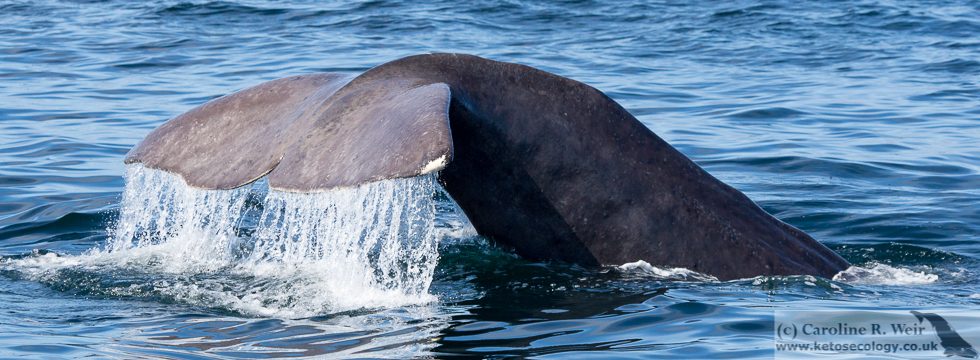
Sperm whales (Physeter macrocephalus) are regularly encountered in deep water regions throughout the world, and this species has been the most frequently recorded and most numerous large whale species during the Angola survey work to date. Although present throughout the year, sightings appear to show seasonal variation with a marked increase between January and May (austral summer and autumn).  Sperm whale sightings have been recorded only in depths exceeding 869 m, and most sightings occur in water depths in the 1000-3000 m range. Sightings usually involve large groups of 10-20 animals comprising presumed nursery groups of females and immature animals (including calves). An exceptional aggregation of well over 100 animals was recorded on a single date in April 2005.  In January 2005 we witnessed an apparent attack on sperm whales by a group of killer whales, details of which can be found here.


Both dwarf sperm whales (Kogia sima) and pygmy sperm whales (Kogia breviceps) are likely to occur off Angola. To date at least 16 sightings of Kogia whales have been recorded during Angola survey work, with the majority identified as dwarf sperm whales from the relative size and position of the dorsal fin.  Most Kogia whales have been recorded during August and September, which is likely a result of the calmer sea states at that time of year which facilitates their detection.  Two sightings were recorded during January 2006.  Sightings have involved small groups of 1 to 3 animals, and have all occurred over deep-water shelf edge habitat of between 1,000 and 2,000 m water depth.


Beaked whales

Beaked whales are notoriously difficult to detect and identify at sea.  We have recorded ten sightings to date during Angola survey work, including an unidentified breaching Mesoplodon beaked whale and two positive sightings of Cuvier's beaked whale (Ziphius cavirostris).  The remaining sightings could not be identified to species or genus, but all were thought to be either Mesoplodon or Ziphius spp.  All sightings have involved single animals or small groups of 2 to 3 whales, and all have occurred over deep waters seaward of 1,400 m.  Ketos Ecology has recently published a paper on beaked whale sightings off Angola in the African Journal of Marine Science (Download here).


Baleen whales

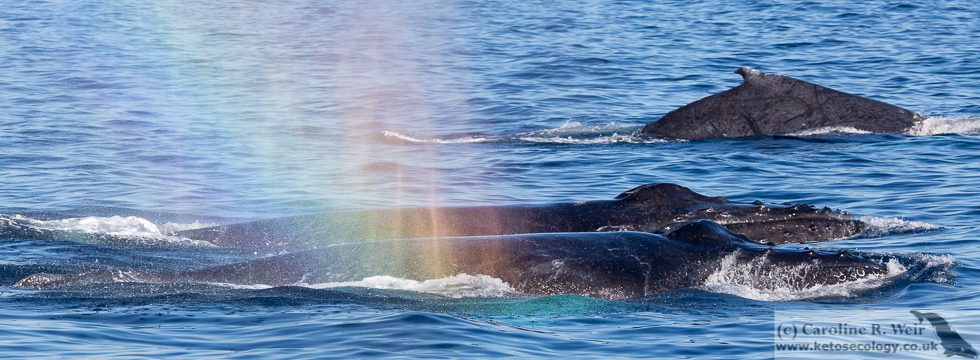
Humpback whales (Megaptera novaeangliae) are the most frequently recorded baleen whale species off Angola, although their occurrence in the region is highly seasonal.  Humpbacks are found in Angolan waters primarily between July and October (Austral winter and spring), when the species utilises West Africa for mating and calving.  For the remainder of the year the whales inhabit, or are travelling between, their Antarctic feeding grounds.  During the Angolan humpback season the density of whales is highest over the continental shelf in waters of less than 200 m depth (including areas immediately adjacent to the coast). However, humpback whales are often recorded in the offshore licence blocks in shelf edge and oceanic areas, and sightings have occurred off Angola even in very deep waters of over 4,000 m depth.  Most sightings involve single or pairs of animals (including cow-calf pairs), but groups of 3 to 6 animals are also frequently observed.  Humpback whales are occasionally sighted outside of the main humpback whale season, with some cow-calf pairs being recorded as late as January. 


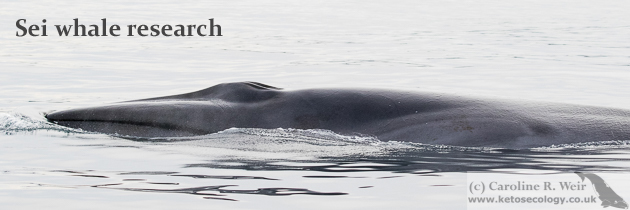
Fin, sei and Bryde's whales have all been recorded during surveys off Angola.  However, a large number of sightings are simply recorded as unidentified 'Fin/Sei/Bryde's whale' due to their distance from the survey vessel and the difficulties in accurately distinguishing between these very similar species.  At least six sightings of fin whales (Balaenoptera physalus) have been recorded, occurring over both the continental shelf (< 200 m water) and over shelf edge regions of 400-1,600 m depth.  Sightings of fin whales occurred during March, April and August, and involved single animals.  One baleen whale sighting has been positively identified as sei whale (Balaenoptera borealis), when two animals were observed clearly in calms seas during August 2004.  


However, the majority of these whales have been identified as Bryde's whale (Balaenoptera edeni), which appears to be reasonably common in Angolan waters.  This is one of the few baleen whale species that does not make extensive latitudinal migrations between feeding and breeding areas, and it may inhabit Angolan waters year-round.  Bryde's whales have been recorded in very coastal shallow regions (including off Luanda Harbour), over the shelf edge, and out in very deep waters (3,000 m), and therefore seem to occur throughout the entire depth range.  Most sightings have involved single animals, but pairs have been seen on several occasions.  Aggregations of these whales may occur in some areas, for example seven whales seen apparently feeding over a small area of the Gabon continental shelf in September 2005.  Many of the individuals show circular scars on their flanks indicative of cookie-cutter shark bites.  

Bryde's whales were also recorded frequently in the shelf waters of southern Angola during a research survey in January 2008.


Ketos Ecology © 2008


Return to the top of the page