Angola: Sep 2005

Back
Angola Whales
Angola Dolphins
Angola Turtles
Other wildlife
Angola: May 2005
Angola: Sep 2005
Angola: Dec 2006
Angola: Mar 2007
Angola: May 2007
Angola: July 2007
Angola: Aug 2008
Sousa Dolphins


During August and September 2005, cetaceans and turtles were recorded during an eight-week survey off Angola.  This time of year is notable for humpback whales, with large numbers migrating through Angolan waters to/from their breeding grounds in the Gulf of Guinea.  A diary of the highlights from this latest period of Angola survey work is posted here:


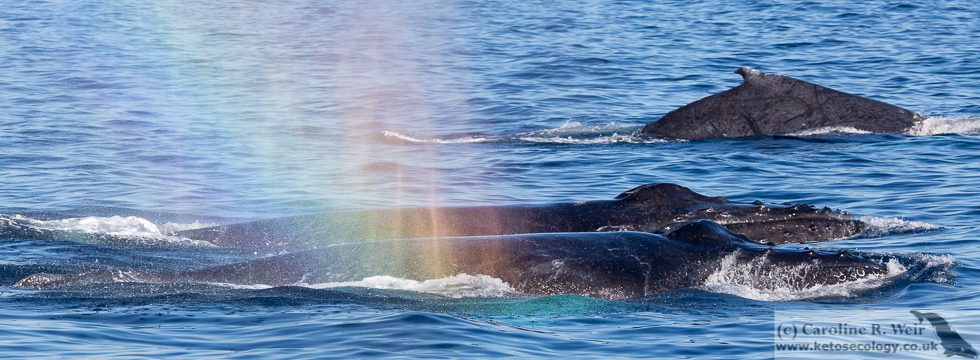
August 11th - After a full day steaming north from Luanda without sightings, we suddenly run into humpback whales!  At least 30 animals spread over a large area in very surface active groups - breaching and lob-tailing for several miles around us.  At this time of year humpback whales are calving off West Africa, and I hope these will be the first of many sightings during the next few weeks.


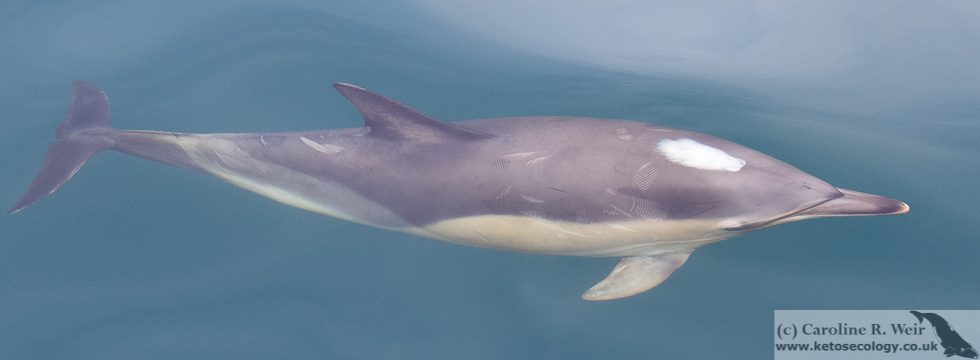
August 12th - I have been watching three humpback whales blowing ahead of us for quite a while before I begin to see the smaller splashes of dolphins appear around them.  And as we approach I realise that there are several hundred common dolphins here, with the humpback whales blowing amongst them.  The dolphins are apparently feeding in an area of strong water currents where the water markedly changes colour.  Some of the dolphins bow-ride the humpback whales, before approaching our vessel and bow-riding that too!


August 13th - Two large humpback whales swim directly up to the seismic vessel, apparently curious about the ship and/or the airguns.  The airgun used in the present survey is extremely small, and perhaps the whales are interested in the regular low-intensity noise being emitted.  The whales turn and travel alongside the seismic equipment for over 30 min, blowing and fluking and even occasionally swimming beneath the towed cable to reappear on the other side. 


August 14th - Hammerhead sharks are numerous here at present.  Their dorsal fins frequently emerge above the water surface, and sometimes the tail fin is also momentarily visible as it moves from side to side and propels the shark forwards.  Although most of the sharks are solitary, occasional small groups of two or three animals can be seen swimming in circles around each other.


August 19th - Most of the seabirds we see offshore Angola are small storm-petrels and terns.  A large dark bird flying past the ship therefore gives me quite a shock!   This bird has a stocky pale bill and is much larger than a sooty shearwater.  The bird follows us for about an hour, and is eventually identified as a white-chinned petrel, an excellent record for northern Angola.


August 23rd - Calm seas today produce two unidentified beaked whales seen at distance, and a group of 25 common dolphins which typically came to play around the ship's bow just as I am having my breakfast!  A humpback whale also appears mid-afternoon, and seems to be in an appropriately lethargic afternoon siesta mood.  The whale lazes at the surface and ambles along just subsurface to produce large slicks or 'footprints' on the water surface.  Finally it musters up enough energy to fluke and disappears from view.  


August 26th - The calm seas continue, enabling me to detect a far-off humpback whale blowing and travelling several kilometres from the ship.  As I pick up the camera to take some distant 'record shots', a smaller dark shape appears at the side of the whale.  A calf!  This is the first cow-calf pair that I have seen out in the deep-water survey area so far this survey, and I am delighted to watch the pair for over an hour as they travel steadily eastwards.


August 27th - The busiest day of the trip so far, due largely to the mirror-calm seas.  Just after dawn a group of common dolphins catch me by surprise by porpoising up our port side and overtaking the ship from astern.  They travel ahead of us across the bow and down the starboard side and are showing every sign of leaving again, when they suddenly turn en masse and porpoise frantically back towards the vessel!  They come to bow-ride for several minutes before finally departing, and we watch them for over an hour more in the distance as they mill around.  But the dolphins are not to be the only highlight today . . .


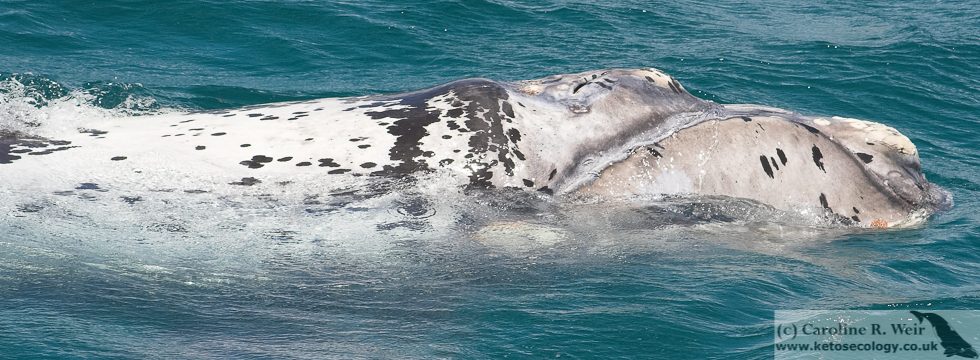
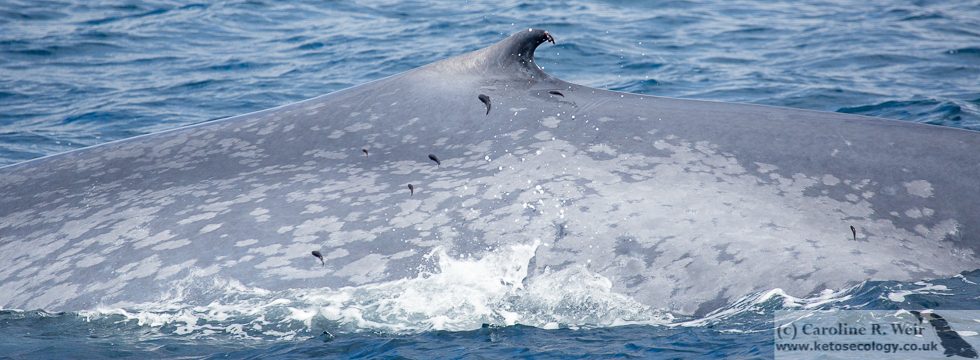
August 27th contd. - 10:13 GMT - The Captain shouts up from the bridge to tell me that he picked up a whale on the radar.  The crew are excellent at detecting whales and large groups of dolphins on the radar during these glassy sea conditions, and I focus towards the area of water where the Captain thinks the whale should be.  What greets my eyes is most unexpected - a low back breaks the surface and a mottled grey-white animal rolls inconspicuously without blowing and disappears back beneath the surface.  I concentrate on photographing the animal as it travels slowly past the ship, still not producing a blow and revealing only the bare minimum of it's back and flanks.  Then, amidst a large burst of spray, the whale tail-lobs once only, and the conclusive white underside of the tail typical of a humpback whale can be clearly seen.  Subsequent analysis of the photographs show a definite humpback whale, but bearing an unusually high level of white scarring.


August 27th contd. - 12:15 GMT - Another brown dot on the water materialises into a turtle, this time drifting close enough to the ship to be positively identified as an olive ridley turtle.  In calm weather the exposed carapaces of basking turtles can be seen well over a kilometre away, and this day alone produces no fewer then 29 turtles.


August 27th contd. - 13:31 GMT - Much excitement (on my part!) as a small whale is seen logging ahead of the ship which I quickly recognise as a Kogia species.  I grab the camera and photograph the distant dark speck.  With directions ("in that calm slick, behind that darker wave, just to the right of that smaller, paler cloud etc"!) I am surprisingly able to get one other person to see the animal just before it sinks beneath the surface and disappears, but two other crew see nothing at all and are understandably sceptical!  The prominence and relative tallness of the dorsal fin indicates that the animal was a dwarf sperm whale rather than the very similar pygmy sperm whale.  Concentrated binocular scanning for the remainder of the afternoon produces two further Kogia sightings, the last comprising three animals logging for long enough at the surface for me to put down the binoculars and attempt another photograph.


August 28th - A burst of splashing a couple of kilometres to port catches my eye.  I knew there were dolphins in the area, but ten minutes ago the group had been porpoising away from the ship at a distance of at least 4 km away.  Now however, it seems the dolphins have changed their minds, and through binoculars I can see them heading rapidly our way!  As the dolphins approach, the yellow/tan hourglass flank markings of common dolphins become readily apparent.  The dolphins decide not to come to the bow, but instead porpoise at high speed past the stern and then away!  I pick them up again 15 min later, and am able to watch them for a further 45 min as they remain feeding in the area.


August 29th - The sun glints off a small, smooth dark shape in the water ahead of the ship, and I take the GPS reading for another turtle sighting.  This turtle appears to be basking - resting at the surface with just the top of the carapace visible.  Unfortunately, it also seems to be directly in the path of our approaching ship.  The turtle only seems to finally acknowledge the ship when it is just 2 m off the bow, and it's head and flippers suddenly emerge above the surface as it takes a panicked breath before diving. 


August 30th - Another olive ridley turtle, but this one is seemingly searching for food within a slick in the sea surface.  About 20 Wilson's storm-petrels are flying in the area too, dipping at the sea surface to pick up small food items.  


And later that day, a small back and dorsal fin suddenly break the surface only 500 m from the ship.  Another Kogia whale, and this one is also a dwarf sperm whale judging from the relative size and shape of the dorsal fin.  The whale logs for less than a minute before disappearing again, and no doubt would have been overlooked altogether in choppier sea conditions.


September 2nd - A dorsal fin breaks the surface close to the vessel, but this time it is only a passing ocean sunfish, its large circular body clearly visible beneath the water.  


September 3rd - A tall bushy blow close to the ship announces the presence of another inquisitive humpback whale.  The whale turns from the ship, arches its back and raises its tail flukes magnificently high into the air.  I expect the dive to cue the end of this encounter, but the whale reappears on the other side of the ship and proceeds to follow the airguns for the next 30 min.  On each surfacing sequence the whale takes one or two breaths and then flukes up to follow the ship subsurface.  I stop watching momentarily to make notes on the data form, and look up to see the entire whale hanging in the air in a full breach!  The whale is airborne for so long that I am actually able to pick up my camera and take a photo of it on the way back down again!  A short while after breaching the whale seems to lose interest in the vessel and heads slowly away.


A few hours later and more blows appear on the horizon ahead of us.  However these blows appear to be unusually frequent - far too frequent in fact to be humpback whales.  The animals are a long way ahead of us, but I already suspect them to be sperm whales.  And this hunch is confirmed 30 min later when I finally glimpse a low back and stumped dorsal hump through the binoculars.  There are at least 10 whales present, but they are spread out in small groups of 1-3 animals and over an area of several kilometres.  Slowly, the group head northwards on long (30-40 min) dives interspersed with long periods of blowing and logging at the surface.  Although we saw lots of sperm whales here in April and May (see May Diary), this is the first sighting for this present survey and it is clear that sperm whales show some seasonal fluctuations in abundance within this region.


September 6th - Only a few hours surveying this morning as we are steaming into Pointe Noire in Congo for a crew change.  However the morning turned out to be very rewarding, with a scattered aggregation of at least 10 humpback whales in the coastal waters west of Pointe Noire including some active flipper-slapping and breaching individuals. 


Just as exciting were the numerous leaping manta rays we observed in the coastal waters.  Small splashes were present all over the sea surface, as the rays leapt out in spectacular back-flips and complete somersaults.


September 12th - A disturbance in the water catches my eye.  The water is breaking over two olive ridley turtles, which are swimming closely together just below the surface.  Their carapaces remain submerged, but intermittently their flippers and heads emerge from the water amidst splashing as the animals interact with one another.  The turtles are either mating or fighting, or perhaps both!  We watch them drift past the vessel, busy with their own behaviour and oblivious to the ship. 


Shortly after, the carapace of another turtle breaks the surface.  The turtle swims quickly away from the ship, pausing only to take two breaths before disappearing.  The large size and red colouration of it's head leaves little doubt that this is a loggerhead turtle, a less common species in Angolan waters.


September 16th - This behaviour was unmistakably turtle mating!  A pair of olive ridley turtles are seen at the surface ahead of the ship, and remain drifting slowly along as we approach and pass them.    


September 17th - It certainly is turtle breeding season in Angola, as today we pass yet another mating pair of olive ridleys!  This time a third turtle is definitely also present, swimming closely around the mating animals.  The ship's course takes us directly towards the turtles, but they remain clinging tightly together even as they disappear from view under the ship's bow and are swept down the side of the ship by the bow wave and safely astern of us.


September 18th - Busy scanning the grey sea with my binoculars, I get a shock when a burst of bright colour speeds across my field of view.  A small bird flies quickly around the ship and then perches on the railings.  The visitor, a grey-headed kingfisher, spends several minutes resting before it is accidentally disturbed by the crew and flies back out to sea.


Later in the day a tall dorsal fin appears ahead of the ship, and the ominous form of a large hammerhead shark comes into view.  We watch the shark swimming slowly in circles and getting nearer to the ship, finally approaching to within several metres of the vessel's side before it becomes aware of us and swims rapidly away.


September 21st - Large blows appear ahead of the vessel, and I lift my binoculars in time to view the wide backs of two humpback whales coming directly towards the ship.  The whales surface two more times and then dive, still heading purposefully our way.  I spend the next ten minutes searching all around the ship to relocate them, as the vessel is currently changing course and the animals are difficult to track.  A large turbulent area of disturbed water suddenly appears less than 200 m off the port stern.  The whales surface with powerful blows and surge through the water revealing their diagnostic knobbly heads and stubby dorsal fins.  After surfacing three more times the far animal lifts its tail flukes and submerges, followed moments later by its companion.  The whales are heading south, returning to Antarctica for several months of summer feeding.


September 23rd - Early morning, and a long dark line in the water many kilometres away catches my eye.  I expect the line to be simply another water current resulting from the Congo River, but I am always in the habit of checking such features as you never know . . . !  In this case, I was right to check - binocular scans reveal the definite splashes from leaping dolphins, and if this area of disturbance is indeed caused by dolphins then it must be a very large group.  The dolphins are heading across the vessel's path, and although still over four kilometres away I begin to see leaping animals and even some dolphins that are turning complete somersaults in mid-air!  Consultation with the bridge crew results in an estimated group size of at least 500 animals and possibly many hundreds more. As the group approaches to within two kilometres of the vessel, some of the dolphins begin to get very aerially active and start to turn towards the ship.  I radio the ship's lab to let the crew know that we have incoming dolphins!  By now I am positive that these are one of the Stenella species, but it is not until the animals begin to porpoise closer in towards the bow that I definitely see the shoulder blazes, white beak tips and spotting that confirm their identification as Atlantic spotted dolphins.  The group is very playful and many animals leap and porpoise in to the ship to bow-ride, although few individuals stay longer than a few minutes.  To our delight, six animals stay around the bow for over 20 min, including three juveniles with no spots at all.  Many of the animals bear the circular scars from cookie-cutter shark bites, and tooth rakes from interactions with other dolphins.  Indeed we see one older spotted dolphin snap aggressively at a youngster that crosses it's path on the bow.  Eventually the vessel begins to turn and the dolphins soon depart after the bow wave wanes. 


September 26th - We are currently en route from Angola up to Gabon to crew change at the end of the survey.  Cruising along the shelf edge off Congo, I notice distant splashes off the starboard side produced by another large group of porpoising dolphins.  These dolphins are heading our way, and as the group approach to within two km of the vessel I estimate that there are over 200 animals present.  Most of the group changes course to pass well astern of our ship.  However I notice a few eager individuals break away from the group and come porpoising at high-speed towards the bow.  I grab camera equipment and dash to the bow myself!  Two dolphins race each other in to the bow wave, and staring through the lens I see that these are not the usual common or Atlantic spotted dolphins.  There is flank pigmentation in shades of grey, and they are clearly a Stenella species.  I lower the camera as the dolphins make a last exuberant leap before arriving at the ship, and see clearly the short dark beaks and dipped dorsal capes that indicate Clymene dolphins.  The dolphins whistle excitedly as they ride the bow-wave, and I can now see easily the black beak tip and thick black line running along the upper surface of the beak.  Also clearly visible at this close range is the diagnostic 'moustache' marking of this species - a thin black line half way along the upper beak.  The dolphins are soon joined by a third individual, and they remain riding the bow wave for several minutes before leaving to join the main group which are more than a kilometre astern of us and heading away with occasional aerial 'spins'.  


September 27th - This was definitely a case of saving the best until last.  The final day of the trip was spent steaming up the coast of Gabon in very interesting water depths along the shelf edge.  Even as I wandered on to deck at dawn there were whales all around the ship - a feeding aggregation of Bryde's whales and some surfacing close enough to the ship to clearly hear their blows.  However it was a few hours later that the action really began, with a mixed-species feeding aggregation of bottlenose dolphins and pilot whales.  The bottlenose dolphins put on a good exhibition of synchronous breaching, and I also noticed a few dorsal fins heading slowly towards the ship.  But there was to be a surprise, for when I got to the bow and peered into the water the dolphins looking back at me were not bottlenoses but rough-toothed dolphins!  Their diagnostic sloped foreheads and narrow dorsal capes were clearly visible as the dolphins remained around the ship for several minutes, whistling loudly and turning slow spirals in the bow wave. 


As we continued into deeper water, another group of about 70 dolphins appeared ahead of the ship.  These were small and active dolphins, and at that range I would normally have to be content with recording them simply as a Stenella/Delphinus species.  However, on this occasion we were in transit, and I asked the Captain if it might be possible to detour over towards the dolphin group to try and confirm their identification.  As we neared the dolphins, many turned towards the ship and porpoised actively in to the bow.  The white beak tips and dark dorsal capes of Pantropical spotted dolphins were clearly visible, and some of the larger animals also had a scattering of fine white spots along their flanks.  The dolphins played around the ship for a short while and then disappeared to resume feeding.


By late afternoon we were back on the continental shelf amidst large flocks of feeding sooty terns and noddys, and the occasional surfacing Bryde's whale.  Humpback whales were also present here in good numbers, and I recorded several tiny calves that had clearly been born within the last few months.  A very satisfying end to a fantastic trip.


With many thanks to the crew of the Sea Trident and to BP Exploration & Production


Return to the top of the page

Ketos Ecology © 2006