|
April
4th - A great day for sperm whales today with an estimated total of at least 111
individuals, although they were difficult to count with blows on both sides
of the ship and right out to the horizon. With several groups of
dolphins observed amongst the sperm whales too, the day's tally came to an
impressive nine sightings and 351 cetaceans.
|
|
April
7th - We are visited by a colourful juvenile Eurasian
Golden Oriole, which lands briefly on the ship's mast before flying
off again.
|
|
April
9th - An exhausted Leach's petrel is found on the deck in the
morning. We put it in a box for the day to rest, and late afternoon
take it to the deck for release.
|
However the release operation is
hindered by the arrival of an exuberant pod of Atlantic spotted dolphins
which come
porpoising in to the ship to play on the bow! This is typical at sea
- nothing for hours, and then everything happens at once! After the
dolphins leave we finally manage to encourage the petrel to leave the ship
and it seems much stronger as it flies away.
|
|
The day comes to a nice end with a pod of 11
sperm whales logging in calm seas just before dark.
|
April
13th - A dorsal fin slices along the water surface - not a dolphin
this time, but a hammerhead shark cruising just below the
surface.
|
|
April
13th - Later in the day a pod of 15
sperm whales are observed, apparently socialising at
the surface. These whales are unusually aerially active with up to four animals
repeatedly breaching over a 15 min period and others tail-lobbing and
rolling at the surface. Although several kilometres from the ship,
the splashes from these breaching animals are enormous and create vast
areas of disturbed white water.
|
|
April
18th - Heavy overcast skies today brought visitors of a different kind
. . . moths! Amazing that these tiny creatures can be found 120 km from shore. Several different species land on the ship
and spend the day resting on various decks and walls. Martin
Honey of the London Natural History Museum identified this particular moth
as Zebronia
phenice (Cramer) (Pyralidae).
|
|
April
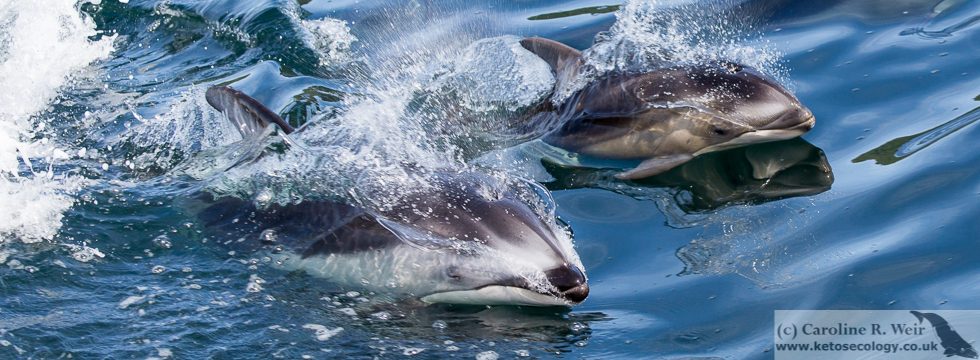
19th - A pod of 45 fast moving
dolphins streak across the bow almost 2 km ahead of the vessel. Often
in the field such pelagic dolphins are so fast moving that it is difficult
to get a good look at their flank markings, but with the added challenge
today of strong wind and the vessel roll producing binocular shake, it is
nigh on impossible. I opt instead to try photographing the dolphins
in the hope that later analysis of the photographs might reveal some
identification features.
|
|
And
zooming in digitally reveals enough of the flank markings to positively
identify these animals as striped dolphins.
|
|
April
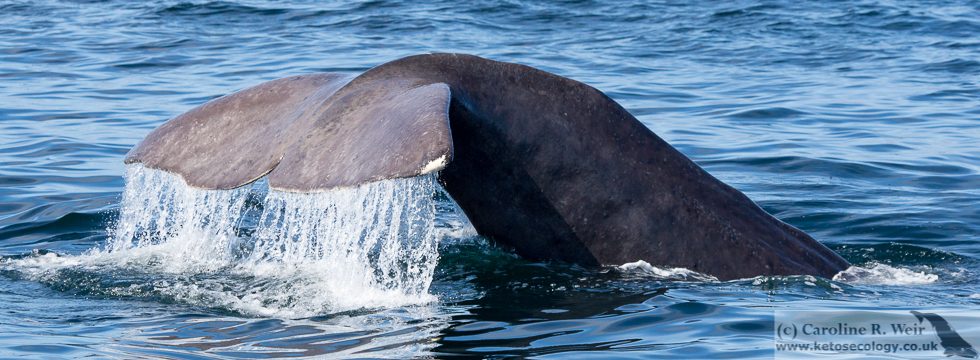
21st - In the afternoon another group of sperm whales are sighted.
The whales are spread out in small sub-groups with a total of around 15
animals. Most of them lift their tails and 'fluke' before
disappearing below the sea, indicating that they are embarking on long, deep dives.
|
|
Later
that day the distinctive wing pattern of a Sabine's
gull flies briefly past the vessel, our first record of this species
since the 6th January.
|
|
April
23rd - Whales have a bad habit of appearing at dawn and dusk when the
light is poor for photography! This morning, a group of 20 sperm whales
surface in their usual scattered array, but with some animals within a
kilometre of our vessel. One whale surfaces between our ship and the
escort vessel, before shallow diving and disappearing.
|
|
A second
whale surfaces even closer to our ship, resting at the surface until only
100 m off the side before sinking beneath the waves.
|
|
April
27th
- A great day with the calmest seas of the survey so far.
Calm weather is when we have most success at spotting turtles, and shortly
after lunch the carapace of a turtle appears ahead of the ship and remains
at the water surface. Basking turtles seem to be quite lethargic,
and I have plenty of time to grab the camera and travel to the bow to
photograph the animal. The turtle (an olive ridley) basks until
right below the ship's bow, when it finally 'awakens' and dives out of the
way.
|
|
April
27th
- I detect more sperm whales blowing several kilometres
away. As we approach, a few animals surface closer and one whale
appears only 500 m off the side of the vessel. This whale logs at
the surface blowing for several minutes, before lifting its tail and
diving.
|
|
May
1st - A cattle egret flew over the helideck today. It
circled around for several minutes and seemed to want to land somewhere, but ships are busy places and it was clearly
unhappy with the deck space on offer! We have seen several cattle
egrets out here since this survey began back in August 2004, so it is
clearly not unusual for them to be occasionally blown out to sea.
|
|
May
2nd
- Today we saw the strange sight of a large bat flying in across the ocean towards the
vessel! The bat flew around the helideck a few times before
finally deciding to roost in a choice sheltered spot on the starboard
side.
|
|
Photographs were sent to Dr Jakob Fahr of the University of Ulm in Germany,
who identified it as a straw-coloured fruit bat (Eidolon helvum).
According to Dr Fahr, this species is one of the most common
fruit bats in Africa and is distributed throughout sub-Saharan Africa. It is known to undertake seasonal migrations as far
as 1500 km in West Africa, and vagrants have been reported at sea up to
400 km off the African mainland. Our
bat was put into a box and sent back to shore with our supply boat. But
we will keep our eyes open for more surprise visitors!
|
|
May
3rd
- Typically I am taking a break when the radio
crackles and the crew on the back deck report that there are 'hundreds' of dolphins along our port
side! And even more typically we are in the middle of a
rainstorm, and the dark skies and rain drops are not ideal for
observations. The Atlantic spotted dolphins (I estimate at least 250 animals) are actively
porpoising in a tightly-bunched group and there are many tiny calves
amongst them.
They seem to be very interested in the paravane which
is towed behind the seismic ship. Probably the paravane creates
noise as it is dragged through the water and perhaps also a bit of a
bow wave. The dolphins escort the paravane for almost 40 minutes,
but never come near to the vessel's bow. Finally they head off in a
frenzied bout of high-speed porpoising which churns up the ocean. |
|
May
4th - A very busy morning - there are dolphins
and sperm whales scattered all around and it is difficult to keep
track of them all. I am just logging another group of sperm whales,
when a mass of white water appears ahead of the vessel and I identify the
splashes from leaping dolphins. After my previous experience (see
April 19th diary) I abandon my clipboard and binoculars and choose instead
to concentrate on photographing these dolphins which are passing about 1.2
km ahead of our bow. I run off a series of digital shots which I
will download later to check the identification of the animals. And
later on . . . the photographs clearly show the intricate flank markings
of striped dolphins.
Probably I would only have been able to
identify these as one of the 'Stenella' species in the field, due
to the combination of the fast movement of the animals and the windy
conditions and binocular shake. The bonus of digital photography has
been proven again. |
|
May
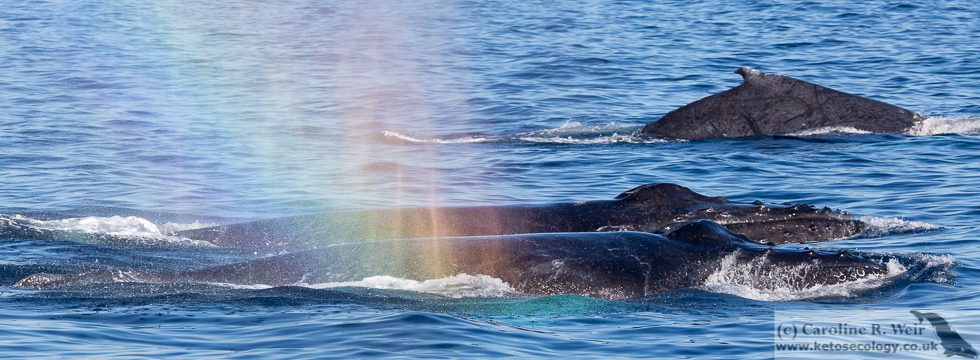
7th - Humpback whales return! A single
animal seen today was the first humpback whale recorded on the survey
since January, and marks the beginning of the return northward
migration of humpback whales from the Antarctic through Angolan waters to their calving
grounds. |
|
May
10th - Another surprise today as a thud on the bridge window marks the
arrival of a beautifully-coloured woodland kingfisher. The bird
settled on a rope at the side of the ship to recover from its flight.
|
|
May
14th - Today produced only the third sighting of false killer whales
we have had in Angola. A pod of eight animals including a calf were
observed for almost
an hour as they milled around near to the survey vessel. Although
they never came within 1 km of the ship, digital photographs taken of breaching animals
clearly revealed the torpedo-like
body shape, conical head and the diagnostic ‘elbow’ in the flippers
typical of this species.
|
|
May
15th - Two pods of sperm whales were encountered today, the final day
of the survey.
An
unidentified rorqual whale was also observed, along with a pod of 5-6
short-finned pilot whales which was our first sighting of this species
since January and ended up as the final sighting of the entire survey. |