|


| |
Ketos Ecology
returned to Angola at the end of January 2007 to record cetaceans and marine turtles during a seismic survey.
Some of the diary highlights of the trip are provided here:
|
January 31st – A line of tall fins break the calm sea
surface, as around 35 dolphins roll and mill around ahead of us.
I am not too certain of the identification of the animals, but
they are certainly large dolphins with prominent fins and I expect
them to be either Risso’s or bottlenose dolphins.
As we draw closer the group splits into two, and one pod turns
to travel down the starboard side of the vessel.
As I focus my binoculars on them, an individual performs
several half-breaches from the water and I clearly observe the
bulbous head and pale anchor-patch on the chest which indicates a
Risso’s dolphin. However,
some of the animals turn to swim towards the ship and I am fairly
certain that I observe a definite short beak on the closest dolphin
before it dives out of sight. The
second group of dolphins are ahead of us and getting close to the bow
of the ship. One
youngster porpoises several times, and this time I definitely observe
the short stubby beak of a bottlenose dolphin.
But there are Risso’s dolphins in this second group too.
The dolphins surface within 50 m of the ship but are not
interested in bow-riding. Instead
they turn slowly away and move out of our path.
But at this close range I can see the round circular bites
from cookie-cutter sharks on the flanks of two bottlenose dolphins,
and the linear scarring along the back of a Risso’s dolphin caused
by interactions with other animals. It is the first time that I have observed mixed schools of
Risso’s and bottlenose dolphins off Angola, although this
association is known in other parts of the world.
|
|
February 1st – A small dark shape breaks the surface close
to the side of the ship, and I glimpse the exposed flipper of a
turtle. The turtle is
very small, and I record it as a juvenile olive ridley turtle, the
most commonly sighted species in Angolan waters.
It takes several breaths at the surface before diving away
from the vessel.
|
|
February 2nd – I have been watching sperm whales for the
last 90 min. A group of
around nine animals on our port side have been logging and blowing,
with one individual performing a long bout of tail-lobbing.
Ten minutes ago I noticed several blows from another sperm
whale several kilometres off our starboard bow, but the animal has
not reappeared since. The
low ‘cotton wool’ bushy blows of sperm whales are difficult to
detect in poor light and choppy seas, particularly when the animals
are often 6+ km distant from the ship. It is 35 min later and the light is falling when I notice a
swirl of water a few hundred metres off our bow.
Nothing appears and I am starting to think I have imagined it,
when an angled bushy blow appears followed by the low dorsal
‘hump’ of a logging sperm whale.
The whale blows several times and then shallow dives, crossing
our bow to reappear on the port side.
As it is almost stationary in the water and we are moving
slowly towards it, the whale comes closer and closer until it finally
dives a mere 100 m off the bow.
|
|
February 3rd – It is rainy season in Angola, and this
morning dawns overcast and with heavy rain showers. The sea alternates between choppy and mirror calm as the
squalls pass through, and the humidity is playing havoc with my
binoculars. I repeatedly
scan the sea surface between the rain squalls, and am lucky to
glimpse the tall dark dorsal fin of a large cetacean surface in the
middle of one of the slicks. The animal is moving quite fast and I quickly lose it once I
have put down my binoculars to note down the time and position.
Scanning around, I finally pick up the fin again, this time
well over on the port side. Some
splashes beyond it indicate that there is more than one animal here
and some dark cetaceans with prominent fins surface rapidly in a
burst of spray and are gone. Another
frustrating sighting and I am only able to record them as
‘unidentified large dolphins’. I have all but given up,
when I suddenly see more fins ahead of us. And through
binoculars I get a clear view of the conical heads and jet-black
colouration of a group of false killer whales. The animals pass
quickly and powerfully across our bow, their heads raised clear out
of the swell waves with each surfacing and with low bushy blows
produced by the largest individuals. As I scan around I
suddenly realise that there are a lot of whales here – there are
sub-groups all around us and all of them are surging purposefully
away to the south-west. I take a few photographs to document them as they pass by,
but false killer whales are fantastic, charismatic animals and I
prefer to get closer views of them through binoculars. This
sighting will doubtless be the highlight of my trip, even though
there are still four weeks of the survey remaining!
|
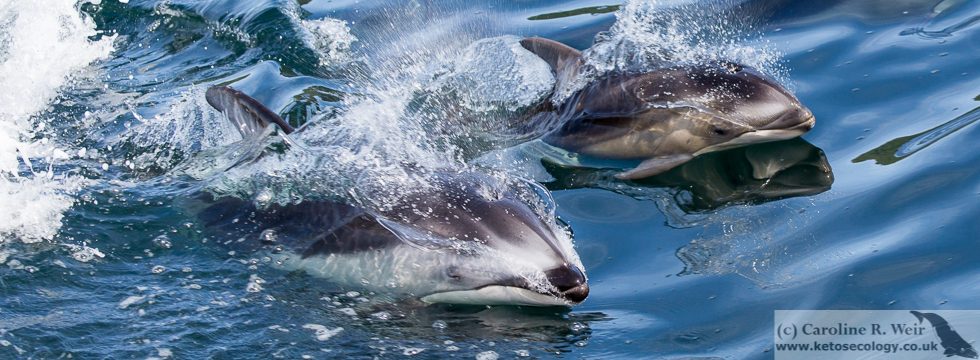
February 3rd – A group of dolphins are porpoising rapidly
down our starboard side, athletically leaping out of the swell waves
and with some higher leaps where the individuals frantically flap
their tails mid-air to gain momentum.
At this speed there is little hope of me identifying them in
the field, and so I photograph them in the hope of identifying them
later. Most of the
dolphins hurry past, but several peel away from the main group and
approach the starboard side paravane for a brief period of play.
The paravane generates a ‘bow wave’ and probably creates
noise below the surface which may be interesting to dolphins.
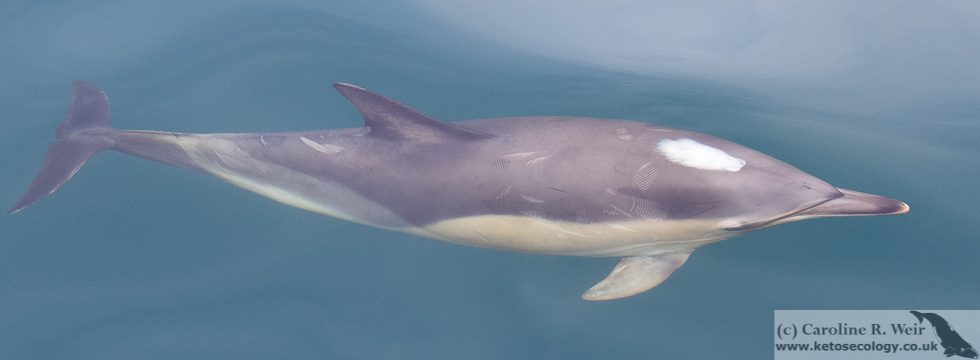
Later analysis of the photographs reveals that these are
common dolphins, probably the long-beaked species, with the tan oval
patch on the forward flank clearly visible.
|
|
February 6th – The sea is very calm today and I have been
expecting some turtle sightings.
But when a turtle finally appears I get a surprise. Instead of the shiny carapace typical of the fairly common
olive ridley turtles, I observe instead the black, ridged back of a
leatherback. The turtle
is large, and the seven longitudinal ridges that extend the length of
its carapace are clearly visible above the surface.
It lifts its massive head to take several breaths before
finally diving off the side of the ship.
Leatherback turtles are critically endangered worldwide, and I
am privileged to have had such a close encounter with this impressive
animal.
|
|
February 7th – It has been busy this morning, with dolphins
on the move. Several
large groups have passed by in the distance, and I have not been able
to identify them further than belonging to either the Stenella
or Delphinus family.
The group I am now watching contains about 90 animals, and
they are porpoising rapidly past the vessel with some high leaps.
The brief views I get suggest that these animals have quite
well-marked flank patterns, and I suspect already that they are
striped dolphins. I have
never seen striped dolphins approach vessels to bow-ride off Angola,
and so I do not expect these animals to come any closer than they
are. I take a few images
for my records, which later confirm the identification and capture
their athletic leaps several metres above the water.
|
|
February 7th – Sperm whales are also prevalent today, with
three sightings of groups of between 1 and 7 animals. I am currently watching three adults as they lie motionless
at the surface, producing their characteristic low angled blows every
few seconds. The nearest
animal is still over 2 km away, but as the sea is so calm I decide to
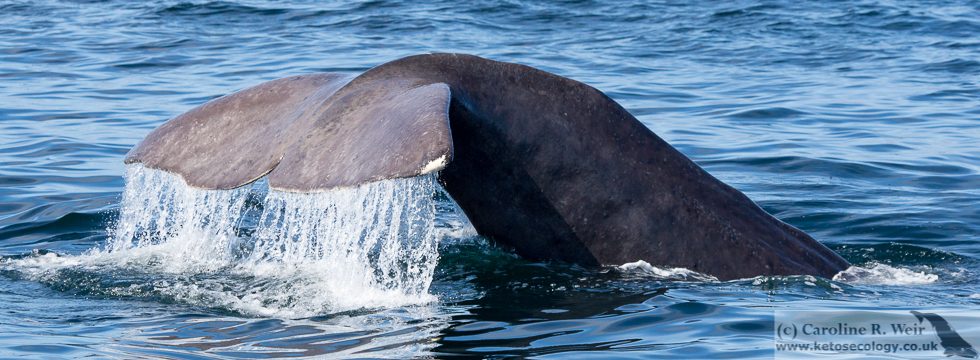
try and photograph the tail. The
whale has been at the surface for a few minutes, and I know it will
probably remain for several minutes more before sounding and
embarking on a long foraging dive.
Just prior to diving the whale makes a forward roll in the
water, revealing part of its back and dorsal fin.
This is my cue, and I raise my camera in time to capture the
whale lift its tail high from the water and disappear beneath the
sea.
|
|
February 7th – A shiny shape in the water catches my eye,
and I see the rounded top of a turtle carapace basking at the
surface. The animal is
almost motionless, but small ripples of water extend in circles
around it and reveal that it is paddling slowly along.
Unperturbed by the approaching vessel, the turtle lifts its
head to take a breath before drifting back through the seismic
equipment and out of sight.
|
|
February 9th – A group of sperm whales are visible logging
at the surface ahead of us, their low, bushy blows scattered across
the horizon. It looks
like our vessel will travel through the middle of the whale group,
with most animals moving across to our port side but a few remaining
out to starboard. I keep
a keen eye open around the ship in case there are any whales in
between these groups that might appear at close range to the ship.
A group of four animals off our port bow are shallow-diving
and moving fairly fast away from the vessel.
I watch them for over an hour before they finally lift their
tails and dive one after the other, leaving oily footprints across
the water surface.
|
|
February 9th – Amongst the sperm whales ahead of the ship I
see a few smaller splashes that look suspiciously of dolphin origin.
And then a large robust looking dolphin leaps high above the
water, crashing back down to create a huge splash.
The sperm whales appear ‘annoyed’ by the dolphins,
shallow-diving in a vain attempt to escape their attention.
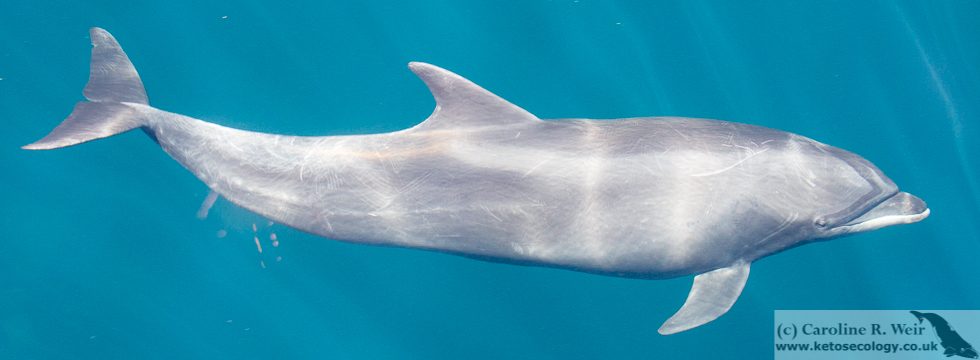
The dolphins continue to move towards us, and the tall dorsal
fins and outline of the leaping animal make me suspect bottlenose
dolphins as their likely identification. There are around 35 animals in total, which is a reasonably
large group for this species offshore Angola.
Often in deep water such as this we observe bottlenose
dolphins travelling with pilot whales, but these animals appear to be
alone. They mill around
ahead of us as if unsure where to go, before heading determinedly
across to starboard and then turning to swim alongside us for a
while. I am able to
glimpse the short beaks as some of the animals lift their heads high
out of the waves when surfacing.
As if in response to some signal, the dolphins suddenly turn
as a single unit and move rapidly away from the approaching ship,
churning up the sea in their wake.
|
|
February 10th – Sperm whales are normally fairly passive
animals, and so I am surprised when the animal I am watching appears
interested in the ship. The
whale has been blowing at the surface for several minutes, but has
just turned in the water to face the ship and specifically the
starboard paravane which is approaching it.
The head of the sperm whale emerges above the water, and I can
clearly see its square shape as the light glints off its forehead.
The animal repeatedly lifts its head from the water, and then
rolls onto its side to reveal its tail fluke.
It then turns in the water to keep facing the approaching
paravane, before I lose sight of it in the sun glare astern of the
ship.
|
|
February 19th – It has been a quiet week, with freshwater
from the Congo River invading the prospect area and resulting in a
lower density of cetaceans. A
group of unidentified Stenella/Delphinus
dolphins porpoising in the distance is my first sighting for three
days, and I have rarely seen Angolan waters so empty.
But typically, having waited several days to see some
wildlife, it is suddenly all here at once!
I have just completed the data form for the dolphin sighting
when a dark shape appears at the surface close to the ship.
It is a turtle, and I easily identify it as a leatherback from
the ridges running along its carapace.
The turtle floats at the surface, and occasionally its huge
head emerges to take a breath. Unfortunately,
due to the lack of action in the preceding days, my camera is still
packed up and it takes me a minute to haul it out of my rucksack and
assemble. By that time
the turtle is floating under the super-wide cable towards the stern
of the vessel. I manage
to take a couple of images just before it takes a final breath and
dives.
|
|
February 23rd – It is a lovely calm evening off Angola and
the low bushy blows of sperm whales are readily visible a few
kilometres ahead of us. I
have seen three animals logging and blowing on our trackline, and
away to starboard there are several more including an energetic
individual which breaches several times to reveal the strange bulky
body shape and square head characteristic of this species.
The whales ahead of us don’t seem to be doing too much.
They drift motionless at the surface with occasional
shallow-diving, but I only see one animal that flukes to embark on a
deep dive. Several
floating grass islands from the Congo River are nearby to the
animals, and myself and the bridge crew undertake a combined search
effort to locate whales and grassy navigation hazards!
We are closing all the time, and six animals suddenly appear
at the surface within a few hundred metres of the port bow and facing
the ship. The whales
rest for a minute and blow several times before shallow-diving.
One animal lingers longer than the others, approaching to
within 60 m of the bow before diving and travelling underneath the
ship to re-appear on the starboard side several minutes later.
Once astern of the vessel, the group reassembles and I can see
their blows in the distance for 40 min longer as we travel away from
them.
|
|
February 24th – The sea is idyllic today, glassy and calm
and filling me with optimism for some good sightings. I have been watching a group of dolphins for well over an
hour, as they hang around off our starboard side with occasional
half-hearted leaps. I am
so busy focussing on the dolphins, that it is Client Rep who alerts
me to a ‘black lump’ floating in the water ahead of the ship.
I take a quick glance through my binoculars to confirm my
suspicions that this is a basking turtle, and I can clearly see the
sun glinting off the top of its carapace.
Often in very calm and hot conditions we observe turtles lying
motionless at the surface in this ‘basking’ behaviour, which is
probably for metabolic purposes. The turtle is right on the vessel trackline, and I quickly
grab my camera and run to the bow in the hope of a close encounter.
I am lucky, as the animal drifts right towards me and then
underneath the bow enabling me to take several nice pictures.
It is an olive ridley turtle, and it has a large remora
hitchhiker attached to its carapace.
Two metres away, the turtle lifts its head from the water and
eyes the approaching vessel with apparent bemusement.
I expect it to take action to move out of our way, but instead
it simply waits there until the bow wave hits it and it is swept off
to the side and lost from sight.
|
With
many thanks to the crews of the Ramform Vanguard and to Total E&P Angola
(Block 32).
Return
to the top of the page
Ketos
Ecology ©
2007
|