|
June
18th - I have been on the ship for less than an hour when
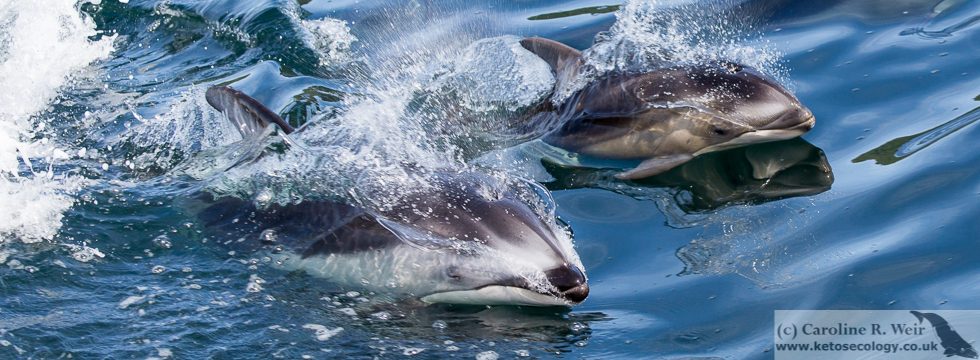
the cetacean action begins. A group of around 60 Atlantic
spotted dolphins porpoise across the bow and perform a few exuberant
leaps out of the swell waves. A great start to the trip! |
|
June
19th - A dark shape rolls at the surface a few kilometres
ahead of the ship, and as I focus my binoculars in the region I see
the diagnostic, large rounded dorsal fins of pilot whales. They are
too far away to confirm, but I expect these are the tropical short-finned
species given the warm water temperature which today exceeds 25°C.
The whales travel sedately in a spread out school of about 15
animals. |
|
June
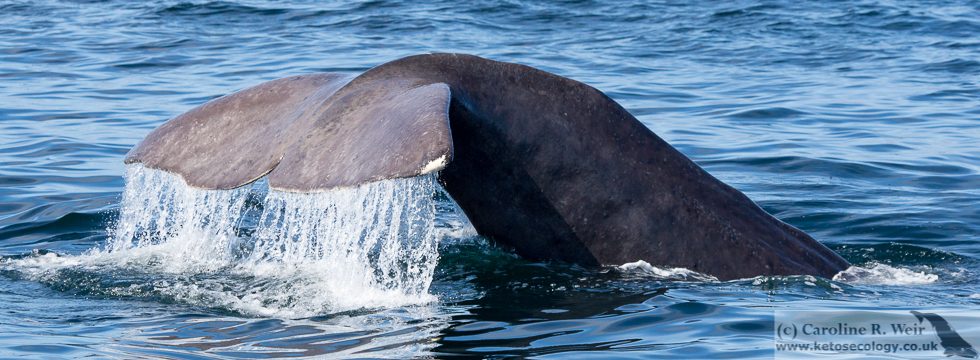
20th - I first saw the low bushy blows of sperm whales
ahead of the ship around 35 min ago. Now, the two animals have
returned to the surface following their dive and are quietly logging
side by side and blowing frequently to replenish their oxygen supply
prior to the next dive. The vessel slowly overtakes the whales
as they lie relatively motionless at the surface. |
|
June
21st - There are lots of sharks visible at the surface at
this time of year, and most of them are hammerheads. This one
approaches close to the ship, and the shape of it's head can be
clearly seen below the water.
|
|
June 22nd - Scanning with binoculars, two huge splashes
towards the horizon catch my eye. There are whales breaching
ahead of us, and this time the crew and I take the opportunity to
launch the small boat and head over for a closer look. The
animals turn out to be sperm whales, their wrinkled skin, low dorsal
'humps' and angled blows making them easily recognisable. We
spend some time with a group of five animals including a calf, which
slowly approach us to within a few metres before shallow-diving and
moving away.
|
|
June 22nd - As if the excitement of the close encounter
with sperm whales was not enough, only two hours later there are
dolphins approaching the ship. The group of around 50 animals
swim slowly and deliberately towards the vessel's bow, their long
beaks protruding above the water at each surfacing. As they
draw closer it is easy to make out the patterning of large white
spots on their flanks and dorsal surface, particularly on the
largest adults which glow white beneath the water. They are
Atlantic spotted dolphins, and around half of the group stop to play
around the bow while the others swim straight past and down the
starboard side. The dolphins are evidently unimpressed with
the slow survey speed and meagre bow-wave, staying for only eight
minutes before peeling away and heading off in search of better
entertainment.
|
|
June 22nd - Less than 20 minutes later more dorsal fins
appear ahead of the ship, and these dolphins are also heading
purposefully but slowly towards the ship. This second school
also comprises Atlantic spotted dolphins, a pod of about 15 animals
including several juveniles. When they reach the bow the
entire group does a U-turn to travel back with us, lazing in front
of the bow-wave, spiralling and generally making much more effort to
bow-ride than the previous group! At least two pairs of dolphins
repeatedly mate while at the bow, and others turn on their sides to
peer up at the ship. One very enthusiastic individual performs two
backwards somersaults as the dolphins leave.
|
|
June 23rd - Splashes
off the port bow alert me to a group of around 25 dolphins, moving
fast through the grey dawn-lit sea. The intricate flank
patterns of the dolphins makes them easily recognisable as striped
dolphins. The animals move quickly through the swell, leaping
out of the backs of the waves and are quickly lost from sight.
|
|
June 23rd - It
is late in the day when a large group of about 90 dolphins appear
ahead of the ship. These animals look very small and with
rather triangular dorsal fins. Although they are definitely
one of the five Stenella dolphin species that occur off West
Africa their identity is not clear, and I take photographs to
examine later. Later analysis of the images reveals the
clearly marked tripartite flank pattern indicative of either spinner
or Clymene dolphins, and the dip in the dorsal cape of some animals
together with the mid-length beak confirm these animals as the
latter species. |
|
June 27th - It
has become habit for me to regularly check around the bows of
passing vessels for playing dolphins, and several splashes around
our chase boat cues me to the presence of 25 animals playing in
their stern wake. The dolphins cross from the chase boat towards our
vessel, but pass by ahead of us and right through the sun glare.
Unfortunately I am unable to identify them beyond being either a
Stenella or Delphinus species. |
|
June 30th - The day is glassy calm and I am unsurprised to
see the carapaces of basking turtles at the surface around the ship.
I am leaning over the starboard railing focussing on one such
turtle, when the Captain shouts to alert me to the presence of two
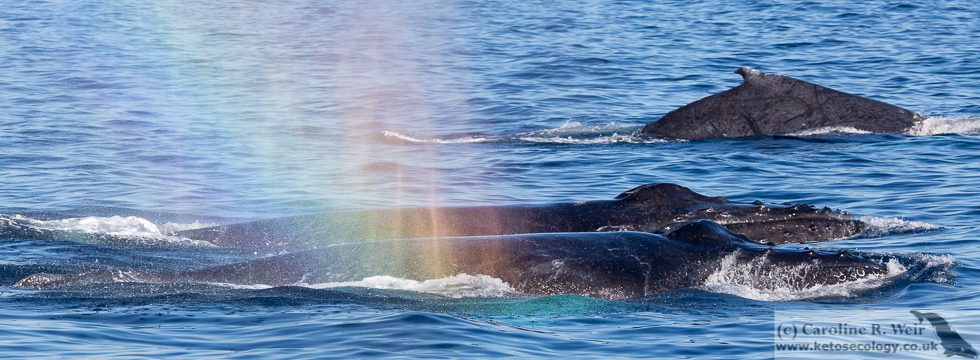
humpback whales passing only 200 m off the port side!
Abandoning the turtle, I am in time to see the whales surfacing
several times revealing their knobbly heads and stubby dorsal fins.
The two adults are heading purposefully north towards their Gulf of
Guinea breeding grounds.
June
30th - Humpbacks are around in good numbers today, with a
single adult later surfacing several times 250 m off the side of the
ship and fluking (lifting it's tail flukes into the air) prior to
embarking on a longer dive. This animal is also going north. |
|
June
30th - The carapace of a basking turtle glints strongly in the
sunshine, and as I watch the animal it's head emerges several times
to take a breath of air. This is an olive ridley turtle, the
species that we see most often in deep waters offshore Angola. |
|
July
2nd - Today we are travelling through waters to the south
of the usual study area, as we head back to the survey site
following a port call in Luanda. Conditions for spotting
animals are excellent, with calm seas and sunshine. It is not
long before the characteristic dorsal fins of pilot whales become
apparent well off to port, and I watch the pod of around 35 animals
travel steadily towards us. The whales are spread out in small
sub-groups and there are several large adult males as well as
younger animals. The group pass astern of us and continue
slowly on their way. |
|
July
2nd - Suddenly there are dolphins everywhere! A very
large pod of porpoising animals can be seen well off to starboard
and heading towards us, while there are some strange animals
scattered all along our starboard side and ahead of us. These
latter dolphins look different from the usual candidates, being
larger and with broad dorsal fins. They are also behaving
unusually, scattered around and generally being elusive. The
larger porpoising group distracts my attention, as the nearest
animals swim purposefully towards the starboard bow. They seem
to change their mind once close to the vessel, and turn instead to
pass astern of us. The covering of white spots and the darker
shoulder blaze indicate that they are Atlantic spotted dolphins. |
|
However,
most of the larger group have detoured to pass ahead of us and then
down the port side, keeping a distance of around 2 km from the ship.
I take some images of the large porpoising school which contains at
least 200 animals. Subsequent analysis showed these animals to
be Pantropical spotted dolphins, their white 'lips', white beak tip
and well-defined dorsal cape being clearly evident.
|
|
While the two spotted dolphin species quickly pass
the ship and move off, the larger unidentified animals from earlier
are still around. And eventually I see ripples on the water
surface that indicate some of them are approaching the ship.
Several crew members have joined me on the bow in the hope of seeing
some close dolphins, and they are not disappointed. Two
animals appear underwater beside the ship, and I am delighted to
distinguish the narrow dorsal capes and slanted head shape of
rough-toothed dolphins. I have seen this species on a handful
of occasions off West Africa, but never in such perfect viewing
conditions. The dolphins are clearly interested in the ship,
and swim continuously in circles ahead of us, looping back to pick
up the bow-wave. Several times they roll on their sides to
look up at the bow with their large eyes, and we are able to see
numerous rounded scars on their flanks caused by cookie-cutter
sharks. After entertaining us for several minutes, the
dolphins peel away from the bow and head after the rest of the
group.
|
|
July
5th - It is another glorious sunny day in Angola, and I
have been watching for only 20 minutes before I have the first
sighting of the day. A group of 40 striped dolphins which
porpoise at high speed past the bow, some animals performing amazing
high leaps and crashing back into the water. |
|
July
8th - An enormous splash several kilometres off the
starboard bow alerts me to the presence of whales. A group of
three humpbacks are travelling north-westwards, with regular
sequences of blowing and fluking, and an occasional breach.
The animals get closer and closer, eventually passing within 1500 m
of the active airgun array without obvious reaction. |
|
July
9th - More humpbacks, this time another group of three
adults which are very surface active. One individual
repeatedly thrashes it's tail on the water surface, churning up the
sea and causing huge splashes. This seems to be a combination
of tail-lobbing, and energetic tail 'swipes' through the water.
Clearly visible is the white colouration on the underside of the
tail flukes, which is diagnostic to this species. |
|
July 9th - During the afternoon we are on 'whale standby',
ready to launch the small boat if any humpback whales are seen so
that we can attempt a closer encounter. After a few hours we
are in luck, with two whales surfacing off our starboard side and
travelling steadily to the north. Several crew members
come along on the 'whale safari' and we head out to try and locate
the animals. Fortunately the tall blows of the humpbacks are
visible above the swell, and we find them without too much trouble.
However, the whales are clearly not as interested in us as we are in
them! They surface close to us on one occasion, the largest
animal fluking right beside us to reveal it's huge tail flukes.
But they are subsequently rather elusive, and we quickly lose them
as they continue on their travels.
|
|
July 11th - I am just returning to watch following a coffee
break when I see dolphins just a few hundred metres ahead of the
ship and porpoising in to bow-ride. A quick sprint to the bow
reveals that some animals are already bow-riding, and even more are
arriving at the same time as me. They are Atlantic spotted
dolphins, and a mixture of adult and juvenile animals. They
stay for several minutes before moving away, with some animals
executing high hanging leaps from the swell waves and the vessel's
wake.
|
|
July 14th
- In the glassy sea the dark shapes of basking turtles are easily
visible. One animal drifts close to the ship and I can
identify it as an olive ridley turtle. The top of it's
carapace has completely dried out, indicating that it has been
resting at the surface for quite some time. |
|
July 16th - There is a large group of dolphins around 5 km
from the ship, and they are actively and purposefully porpoising
towards us. Sometimes it is possible to sense when dolphins
are in an interactive mood, and this group is showing all the signs
of deliberately seeking out the vessel. As the animals
approach I can see that the group consists of several hundred
animals, and they show the diagnostic 'hourglass' flank markings of
common dolphins. As they arrive at the bow, the dolphins turn
to swim in front of, and alongside, the ship. We can hear loud
whistles from the animals riding the bow wave, and audible all
around are the sharp exhalations of surfacing dolphins and the loud
slaps as animals leap from and re-enter the water. The
dolphins remain playing around the vessel for over 45 minutes, and
many of the crew are out on deck to view the spectacle.
|
|
July
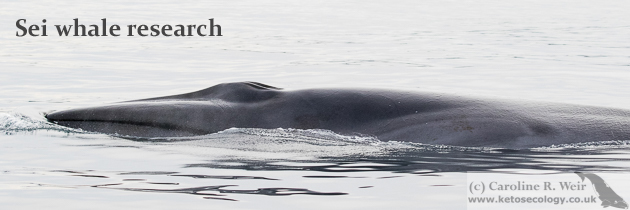
18th - The tall vertical blows I have been watching
certainly do not belong to a sperm whale. And they look far
too slender to be a humpback either. It's not until the animal
gets closer that I am able to make out the long, smooth back and
prominent falcate dorsal fin that identify the animal as either a
Bryde's or a sei whale. The flanks of the animal are covered
in numerous small circular scars caused by cookie-cutter sharks. |
|
July
18th - A tall dorsal fin at the surface signals the
approach of a shark. As the animal passes close to the ship we
can see the distinctive head shape of a hammerhead shark below the
surface. |
|
July
18th - It is late in the evening when a group of low, bushy
blows alert me to the presence of sperm whales off our port bow.
And there are many animals here . . . as I search around I see more
and more blows scattered many kilometres away. Some of the
sperm whales come fairly close as the vessel turns amongst them,
their low backs and dorsal 'humps' easily visible in the calm sea. |
|
July
25th - The group of around 30 Atlantic spotted dolphins
catch me by surprise, porpoising in from an area of intense sun
glare so that I don't see them until they are already close to the
ship. The dolphins stop to play briefly around the bow.
This seems to be a nursery group containing adults with many calves
and juveniles. The dolphins quickly lose interest in our slow
speed, and move off to starboard. But only a minute later they
can be seen 'running' at high speed away from the ship in an
apparent reaction to the cables on our starboard side. |
|
July
26th - I have been watching the group of dolphins several
kilometres off our port side for 20 minutes before they start to
head purposefully towards us. The animals finally decide to
approach the ship and spend a few brief minutes bow-riding and
surfing alongside us. As before, this group of Atlantic
spotted dolphins contains quite a lot of calves and juveniles, the
youngsters staying close to the adults' sides. The
dolphins quickly lose interest and move away.
|
|
July
26th - I am being spoilt today! Only an hour after
the previous group we spot more dolphins ahead of the ship, and this
time the school is larger and looks much more active. There
are about 60 Atlantic spotted dolphins here and they do not hesitate
to approach the ship, some porpoising energetically to the bow and
others in a more sedate manner. The dolphins spend 20 minutes
playing around the bow and surfing the ship's wake alongside.
As they move off they leap out of the swell waves in spectacular
fashion, some dolphins turning complete somersaults mid-air.
|
|
July
28th - The final day of the survey brings one last group of
spotted dolphins to visit. The group initially looks like it
will pass well ahead of us, but some animals stopping and
somersaulting in the middle of the school make me think that at
least some exuberant youngsters are keen to play! Eventually
they turn, and the most enthusiastic dolphins porpoise at speed to
the bow. However, the majority of the school simply stop in
the water ahead of us and wait for the ship to arrive . . . they are
obviously aware of our low survey speed! The dolphins play
around the bow for several minutes, with some surfing alongside and
jumping out of the waves. An excellent end to the survey.
|