|
November
28
– The first cetaceans of the trip were recorded from the helicopter
on the journey from Luanda offshore to the survey vessel. Two groups of sperm whales were seen lying at the surface,
and a vast area of white water indicated a large dolphin group on the
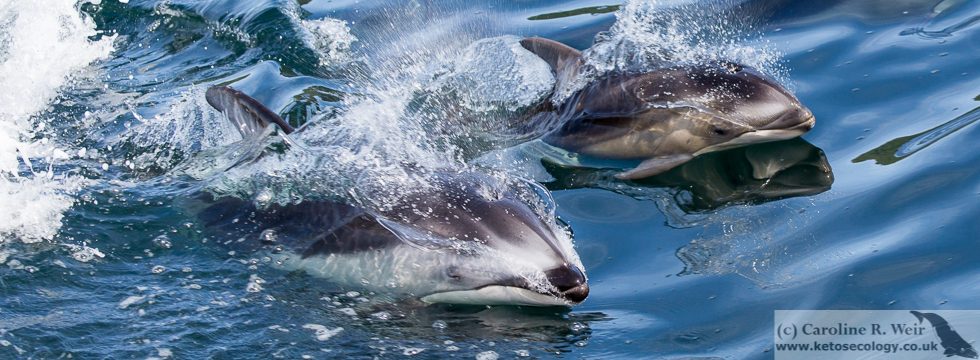
move. Not a bad start! A pod of around 35 Risso’s dolphins seen ahead of the ship
later in the afternoon proved initially challenging to identify, appearing suspiciously like one of
the smaller blackfish species in the poor light. |
|
November
29 – A busy day with a group of nine sperm whales observed for
over an hour in the morning as they lifted their tails to embark on foraging dives. The first of many groups of unidentified ‘Stenella / Delphinus
dolphins’ were also recorded, the distance from the ship and the
similarities between these small and active dolphin species
precluding positive identification.
|
|
November
29 – After
a relatively quiet afternoon a splash off our port bow alerts me to a
small group of around 15 animals travelling slowly between our vessel
and the accompanying chase boat. They appear to be large dolphins, with rather broad and
upright fins and dark in colouration.
Unsure of their identity, I pick up my camera and take a few
shots as they move sedately away from the ship.
Later analysis of the images indicates that these animals are
most probably melon-headed whales or perhaps pygmy killer whales.
|
|
November
30 – The rainy season is in full flow today, with torrential
rain squalls and thunder restricting visibility and churning up the
sea surface. It is
mid-afternoon before the rain clears sufficiently for me to head
outside and start scanning for cetaceans.
But as I scan across the horizon with my binoculars the misty
vapour of a whale blow appears, shortly followed by two
large triangular fins. Killer
whales! They are milling
in the area of a slick with a storm petrel zig-zagging around them,
and I wonder if perhaps they have recently killed prey here.
The killers sound, and subsequently reappear several minutes
later off our port bow and moving towards us.
Now that they are closer, I notice a small calf amongst them.
After one close surfacing sequence, they dive and disappear.
We look all around the ship for them for 15 min, but cannot
relocate them.
|
December
1 – An insect invasion today!
A variety of large insects and moths fly all around the ship,
presumably carried offshore by the rain clouds.
|
|
December
2 – Dorsal fins appear on the edge of the sun glare. I can tell immediately from their tall and falcate shape that
these dolphins are different to the several groups of ‘Stenella / Delphinus
dolphins’ that I already recorded earlier today.
I watch them curiously as they simultaneously roll and sound,
some of them lifting their tail-stocks and flukes clear of the water.
When the dolphins reappear they are only 300 m off the side of
the ship, and have turned to swim alongside us.
Their bulbous heads and the visible pale colouration on some
individuals readily identifies them as Risso’s dolphins.
One large animal breaches three times, landing heavily on its
side with clearly audible splashes.
|
|
December
3 – A brown shape in the water catches my eye, and I raise my binoculars
just in time to see the round carapace of an olive
ridley turtle break the surface.
The turtle takes a few breaths, before diving deeply and
disappearing from sight.
|
|
December
3 – Another turtle, and the distinctive longitudinal ridges
along the
carapace identify this animal as a leatherback.
The turtle rests at the surface and takes numerous breaths,
passing alarmingly close to the cable that is towing some of the
seismic equipment astern of us but without showing obvious reaction.
|
|
December
3 – In calm, blue seas, the splashes from leaping dolphins
ahead of us are easily visible. The
animals are widely spread, and the number
of splashes suggests a large group size.
I scan the area repeatedly, monitoring the whereabouts of the
animals most of which appear to be at least a kilometre ahead.
And so I am caught off guard when splashes beside the bow
indicate that some dolphins have sneaked in from elsewhere to
bow-ride! When I peer
over the bow I can see two slender grey dolphins, and the white beak tips and speckled white flanks indicate that
these are Atlantic spotted dolphins, one of the most common dolphin
species in Angola. They
whistle loudly and swim circles around the bow, unimpressed by our slow
speed. As if on cue,
dolphins suddenly appear from all directions.
They spend 30 minutes playing in our bow-wave, and we observe
small calves, boisterous juveniles and even a mating pair.
|
|
December
3 – On my return to the observation deck after the dolphins
have departed, I notice a small, colourful bird resting on the lower
decks. This is a Rufous-vented
paradise flycatcher which is endemic to central Africa, and it has probably been blown
so far offshore by the
prevailing rainy weather systems.
|
|
December
3 – Just before dark I detect the unmistakable huge swept-back
dorsal fins of pilot whales. The
group of around 25 animals includes two small calves and several
enormous males, and they swim serenely across our bow before stopping
and logging off the port side. Pilot
whales often seem curious about the survey vessel, and I notice one animal
spy-hop as if to take a better look at us.
|
|
December
4 – The low bushy blows ahead of the ship are angled forwards
and are easily identified as belonging to sperm whales.
The whales are scattered over several kilometres of water, in
small sub-groups of 1 to 4 animals.
As I watch, some of the whales roll at the surface and lift
their tails, commencing deep foraging dives.
Others are still surfacing from previous dives, and I estimate
around 20 animals in total. Two
pass very close to our chase boat, apparently without disturbance.
|
|
December
4 – A tall and pointed dorsal fin is circling at the surface
close to the ship. The
appearance of a tail fin confirms the presence of a shark, and the
water surface is calm enough for me to make out the distinctive head
shape of a small hammerhead shark.
|
|
December
10 – Although the splashes of leaping dolphins are difficult to
distinguish amongst the numerous whitecaps, I am sure it is quite
a large group that is currently playing around the bow of our chase boat.
As I watch, the dolphins begin to move in our direction,
slowly at first, but then with increasing momentum as they surf the
swell waves and start leaping and somersaulting out of the back of
the waves. I reach the
bow before they do, and wait to see the first animals arriving where
at this close range I easily identify them as Atlantic spotted dolphins.
Some of the dolphins stay to bow-ride, but the bigger
attraction today seems to be the huge waves being created down our
port side as the vessel rolls against the swell.
The dolphins line up in successive waves, surfing and leaping
high out of the top of each wave. For a few seconds it appears as though every single wave in the
ocean contains dolphins, and then quickly they are gone, the only fin
remaining belonging to a lone hammerhead shark which cruises slowly
past the ship.
|
|
December
11 – Some floating debris in the water catches my attention,
and I identify a large white sack!
It has become a habit for me to check such items for associating turtles, since
the turtles often accompany objects in the water presumably to feed
on attached invertebrates. I
am lucky this time, as a brown shape rises to the surface and the
head of a turtle appears to take a quick breath of air.
|
|
December
11 – We have been waiting for several days now to find more
pilot whales in suitable weather conditions to allow a small boat
trip. I am hoping that
we might be able to approach close enough to some of these animals to get good views
of their flippers and flanks so that we can confirm whether the pilot
whales in this area are definitely the short-finned species rather
than long-finned. It is
probable that both short- and long-finned pilot whales occur off
Angola, but in northern areas such as this where the water
temperature exceeds 25°C it is almost certain that the tropical
short-finned species predominates.
Fortunately, the crew are also keen to head out for some
‘whale-watching’ and within 15 min of my spotting some pilot
whale fins we are
heading out towards them in the Fast Rescue Craft.
The pilot whales are travelling slowly but purposefully and
are spread out in small sub-groups. The animals are taking fairly long dives and are initially
rather difficult to approach. However, we spend 20 min moving slowly
alongside them and eventually we are able to get sufficiently close
to confirm the identity of these animals as the short-finned variety.
The whales lack the pale dorsal cape and eye blaze that are
characteristic of some other Atlantic short-finned pilot whale
populations, and instead appear uniform black in colouration.
For a few minutes we switch off our engine and drift amongst
the whales, the only sound being their sharp exhalations as they
break the surface. A
small unit containing a mother and calf swim slowly past us, the
mother carefully keeping herself positioned between us and the
youngster.
|
|
December
11 – A strange bird is flying around the ship, its long and
narrow wings looking suspiciously long for its body size.
This is certainly not a seabird, and I watch as it lands on
the helideck for a rest. The
visitor is a nightjar, and this is the second time that I have seen one
offshore Angola.
|
|
December
13 – Pelagic dolphin schools in Angola are often seen
‘running’ or ‘porpoising’, travelling at high speed in
smooth, shallow forward-leaps. The
group of around 50 dolphins I am watching now have been moving this
way for 30 minutes, and although it looks very high-energy behaviour,
it is actually considered to be one of the more energy-efficient ways
for dolphins to travel. The
animals seem to be above water for only the blink of an eye, and I
quit trying to identify them through binoculars and opt instead to
take photographs. The
dolphins freeze-framed in my camera were later identifiable as
Atlantic spotted dolphins.
|
|
December
14 – The sun glints strongly off several dorsal fins ahead of
us. These dolphins are
large with very prominent falcate dorsal fins.
They also look a very brownish colour in the sunlight, and
can’t be Risso’s dolphins. I
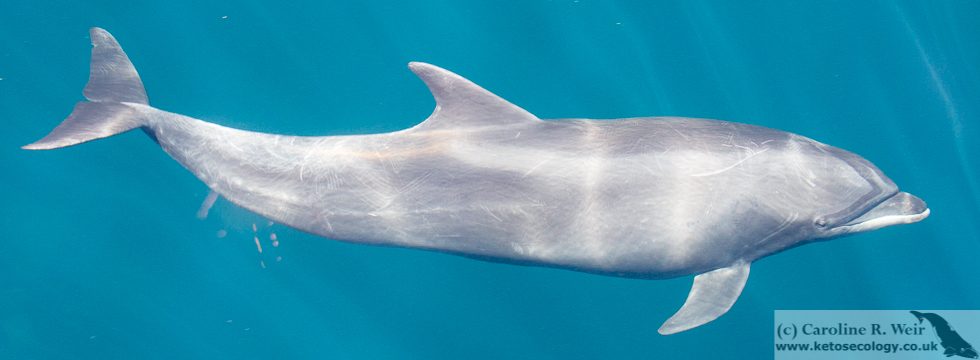
suspect bottlenose dolphins, and this is later confirmed from the
photographs which show the short, stubby beak diagnostic of this
species. It is fairly
unusual to see bottlenose dolphins alone in these deep waters, since
they are most often seen associated with pilot whales.
|
|
December
14 – Thirty minutes ago I was fortunate enough to observe two
distant beaked whales, and I am so busy scanning the horizon trying
to relocate them that I almost miss the tall dorsal fins that appear
a few hundred metres off our bow.
The sea and light conditions today are perfect, and there is
no mistaking the bright white colouration of Risso’s dolphins which
pass closely to the bow before lifting their tails and diving off our
starboard side.
|
|
December
20 – The dolphins ahead of us are some of the most acrobatic I
have encountered so far on the survey.
Some individuals leap repeatedly several metres into the air,
hanging there for a second before dropping back onto their sides
creating huge splashes that are visible for miles around.
These are striped dolphins, and I watch them for over an hour
as they feed and continue to perform their acrobatics.
|
|
December
20 – It is late evening and I am watching several groups of
unidentified ‘Stenella / Delphinus dolphins’ feeding around the vessel.
The mirror calm seas allow me to view some very distant
animals, their backs and fins appearing as little more than small,
black dots. I am
monitoring one such group, when two larger animals roll at the
surface several kilometres away.
I quickly recognise the long, sloped backs and tiny triangular
dorsal fins as belonging to beaked whales, but although I can make
out the bow-waves from their foreheads, they are too far away to see
the beaks. The whales
roll together at the surface nine times before disappearing.
|
|
December
21 – The low blows look fairly strong in the bright dawn sunlight,
but I don’t think these are whales.
A brief glimpse of a tall fin amidst the swell suggested
dolphins, and as the animals emerge from the sun glare, I see that they are
Risso’s dolphins, surfing slowly in the swell.
This is the third group of Risso’s dolphins that has
travelled past the ship today, and with a total of over 40 animals
the feeding must be good for them in this area at the moment.
|
|
December
21 – I photograph a strange fin close to the
ship. The fin is tall,
thin and very sickle-shaped, and appears at the surface
intermittently usually out of a swell wave.
It initially took us several sightings of these fins before we
worked out that they are the tail fins belonging to large billfish
– marlin, sailfish and similar species.
|
|
December
22 – I have been tracking a large group of dolphins for the
last hour, when sperm whale blows appear directly in front of the
dolphins and right on our track line.
The whales are elusive . . . in contrast to their usual
behaviour they are mostly shallow-diving and are travelling fairly long
distances subsurface between consecutive surfacings.
However, they are spread out, and it quickly becomes apparent
that we are going to sail through the middle of the group.
I am monitoring two whales that are logging over a kilometre
off our port side, when I notice the wrinkled stationary form of a
sperm whale lying at the surface only a few hundred metres ahead of
the ship. The whale
eventually responds to our presence, rolling its back slightly and
shallow-diving out of the way. Another
individual logging around 500 m off our port bow is clearly preparing
for a deep dive, rolling its back strongly to submerge before
producing one last powerful blow and lifting it’s tail into the air
to disappear into the depths.
|
|
December
24 – We are in the middle of a re-fuelling operation at sea,
but perhaps this just further arouses the curiosity of the pilot whales.
They swim slowly towards the bunkering vessel and pass only a
few metres ahead of it. A
large male positions itself between the ship and the remainder of the whale pod.
When they get abeam of the two vessels, they stop and remain
logging at the surface for several minutes, the setting sun glinting
off their dorsal fins. There
is another group of pilot whales off our starboard side, and I
estimate around 30 animals in total.
There are splashes from active bottlenose dolphins associated
with the second group, but the pilot whales themselves appear relaxed
as they rest quietly at the surface..
|
|
December
27 – An area of disturbed water near to the bow catches my eye
– it looks different from the frequent small splashes produced by
the tuna that swim continuously alongside our vessel. I
focus on the area and see a small brown oblong moving subsurface away
from the splash. Eventually
the shape rises to the surface to take a breath, and I am able to
identify a small olive ridley turtle.
On some parts of its head and carapace the turtle is covered
in very bright red algae. It takes several more breaths as it moves sedately astern of
us, before disappearing from view.
|
|
December
27 – More pilot whales, this time a small pod of 10 animals
that approach to within a few hundred metres of the ship.
As they turn towards the sun, the light catches the low, bushy
blows produced by the larger animals as they surge through the swell
waves.
|
|
December
29 – My final morning at sea this trip. However, in stark
contrast to the choppy seas earlier in the week the sea today is
glassy calm! I expect to
see a lot of activity when the conditions are as favourable as this, and I
am not disappointed. The
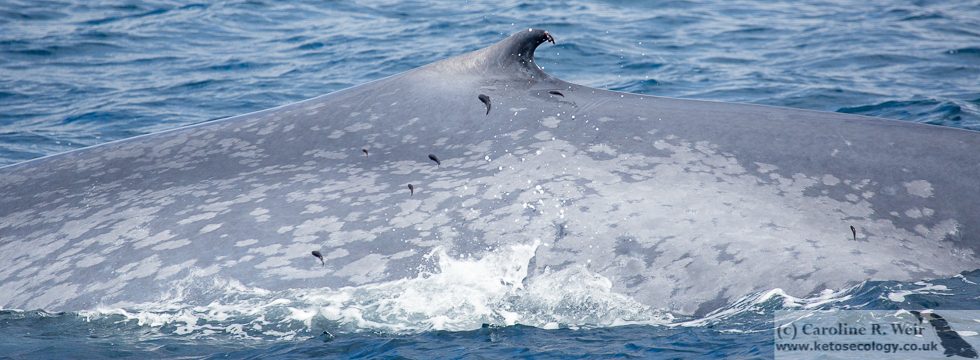
day begins with a tall, vertical blow that I easily recognise as
belonging to a baleen whale of some kind.
In the calm weather I am able to photograph the back and
dorsal fin and confirm this animal as almost certainly a Bryde’s
whale.
|
|
December
29 – The blows that I see a few hours later are the low, angled
blows diagnostic of sperm whales, and I can clearly see their backs
and low dorsal humps lying at the surface like giant logs.
The whales are widely scattered and difficult to count, but I
estimate at least nine animals in the group.
As I watch the two closest animals, the nearest gives the
characteristic shallow roll that indicates that the next surfacing
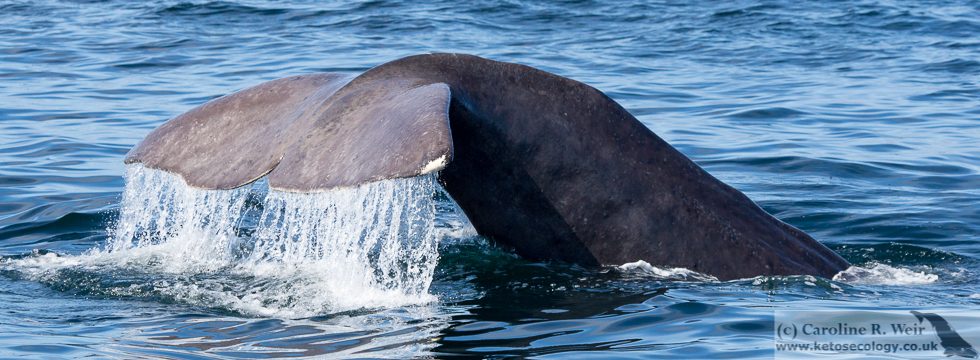
will be it’s last. I focus my camera on them and watch as the whale produces a
final blow and then rolls to lift its tail clear of the water and
dive, closely followed by its companion.
|
|
December
29 – We have seen the glint of a turtle’s carapace well over
a kilometre ahead of us on the vessel’s trackline.
The turtle is basking at the surface and we are hopeful of
getting very close views, since they are often slow to react to the
approaching ship when basking. As
the turtle gets nearer I move to the bow and can see the round shape
and numerous scutes of an olive ridley turtle.
Like the turtle I saw last week, this individual has a thick
covering of reddish algae on some parts of its carapace.
The turtle does not react to the ship until it is immediately
under the bow, when it suddenly awakens and dives rapidly out of the
way.
|
|
December
29 – More sperm whales, and this time at least 20 animals.
Most of the whales are distributed a few kilometres away along
our port side, but some surface rather close off the starboard side
of our ship after apparently diving underneath the survey vessel.
After surfacing, most of
these close animals shallow-dive and move fairly quickly away from
the vessel as if unsure about it’s proximity.
One large whale moves rapidly away beneath the water, and we can see
the ‘footprints’ from the movement of its tail flukes before it surfaces again
on the far
side of the towed seismic equipment.
|
|
December
29 – We are so busy watching the sperm whales that we almost
miss another olive ridley turtle!
The turtle appears close to the ship, and swims slowly along
the surface with it’s head frequently emerging to take breaths.
|