|


| |
|
Some
of our field notes from the 2009 field season are archived here:
|
|
13 December
2009:
Research boat,
Stonehaven, Scotland
09:11 GMT
"We
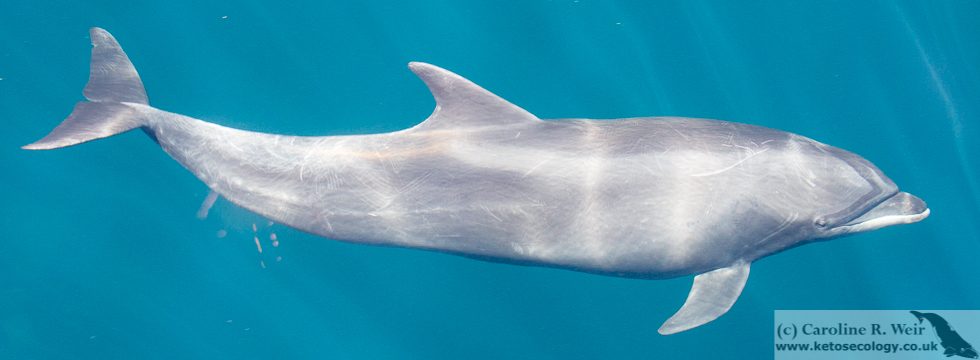
have had rotten luck with our bottlenose dolphin photo-identification
surveys this year. Although we are used to struggling with a lack of
suitable weather conditions, we have also struggled to find dolphins in
2009. Quite a few of our boat surveys during the first half of the
year failed to encounter dolphins, and it has been a similar story during
the autumn. In the summer months we focussed more on white-beaked
dolphins further offshore, but our forays along the coast did not encounter
bottlenose dolphins then either. It seems either the dolphins have
spent more time in other places this year, or we have simply been very
unlucky in our attempts to find them. A lack of dolphins (relative to
previous years) during shore-based watches suggests the former might be the
more likely explanation. Today we decide to head south from Stonehaven
towards Montrose, since a local at Inverbervie informed us that he has seen
a small group of dolphins several times in the preceding week. Sea
conditions are good, but it is very cold despite our donning several layers
of thermals and ridiculous furry hats with ear-flaps! We turn back at
St Cyrus without encountering any cetaceans, although there are numerous
grey seals hauled out along the rocks and feeding in the water. A
couple of porpoise sightings on the way home do nothing to inspire my
confidence about finding dolphins - we don't usually see both bottlenose
dolphins and porpoises on the same surveys, perhaps a result of the
antagonistic encounters that have been observed between these two species.
We are almost back at Stonehaven when a movement a kilometre or so ahead of
the boat catches my eye. I am pretty sure that was a dolphin, but its
so long since we saw dolphins here that I wait for a second animal to
surface before I shout out the sighting! Finally! We turn the
boat in their direction and head over to find a small group of four adult
bottlenose dolphins travelling purposefully southwards. The first
animal to approach our boat is instantly recognisable by the distinctive
nick in her dorsal fin - it's 'Sooty' (ABZ5), one of the most
frequently-sighted animals in our study area. A large dolphin
surfacing next to her is also very recognisable to us - 'Brookie' (ABZ10)
who is seen most years off Aberdeen. The other two animals are less
familiar. One has a very broad dorsal fin with a rounded tip, which
totally lacks any nicks or notches and will consequently remain
unidentified. And the final animal is one I recognise from our
catalogue but I haven't previously encountered myself. 'Spike' (ABZ50)
has a very thin and pointed dorsal fin with a distinctive pattern of small
notches in the trailing edge.
|

ABZ 5
- Sooty |

ABZ 10
- Brookie |
|

ABZ 50
- Spike |

Unmarked dolphin |
Unlike the other three dolphins, Spike
maintains a distance of around 20 m from the boat and does not seem eager to
approach any closer or bow-ride. The others, however, travel along
together and occasionally dash in towards the boat to ride the bow-wave
before disappearing beneath the water and re-surfacing somewhere random.
Sooty in particular is often very playful around our survey boat and
although their behaviour today is generally rather quiet, she doesn't
disappoint...in quick succession she performs three breaches close to the
bow, turning her head to glance at the boat as if to make sure we are
watching! We stay with the dolphins long enough to take identification
photographs of everyone's dorsal fins, and then head back to harbour and a
welcome cup of warming coffee".
|
|
31 October
2009: Balmedie beach, Aberdeen
10:07 GMT
"It's
always sad to see cetaceans stranded ashore, but at the same time such
events provide a fascinating opportunity to examine these animals at close
range. Large whales in particular provide little more than tantalising
glimpses of backs and tails at sea, and its not until these animals wash up
on beaches that their vast bulk can be truly appreciated.
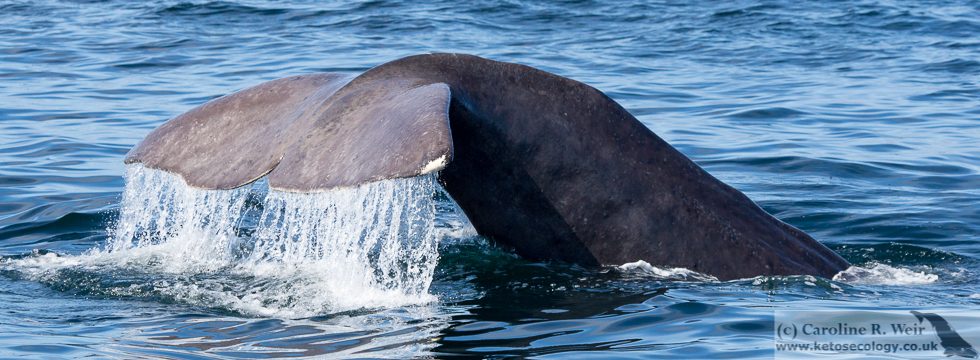
Unfortunately the dead sperm whale that we have come to observe this morning
is not quite on the beach, but is rather rolling around in the surf a short
distance offshore. We should have checked the tide times before we
arrived! A crowd of onlookers are stood on the beach, perhaps the only
chance some of them will have to observe such a large, mysterious animal at
close range. The whale's broad tail flukes flap around in the breaking
surf, causing several people to wonder whether the animal is still alive.
But the whale's blow-hole remains firmly closed. It's lower jaw hangs
loose, revealing a row of large conical teeth used to capture it's squid
prey in the deep-water habitat in which sperm whales thrive. The cause
of death is not obvious from this distant examination of the corpse.
Possibly the whale simply took a wrong turn and ended up in shallow North
Sea waters far from its usual habitat".
|
|
23 October
2009:
Survey vessel,
Gabon
09:48 GMT
"We
passed over the shelf edge and into deeper water some time ago, and I have
had my eyes peeled for the variety of deep-water cetacean species known to
inhabit this region. Although the sea surface is covered in whitecaps,
large splashes several kilometres ahead of the ship catch my eye.
Through binoculars I can see the white bellies and glossy dark backs of
leaping dolphins. These high acrobatic leaps into the air are usually
indicative of one of the
Stenella species, and I wait with anticipation to
see if we will get a closer look. As we approach the dolphin school,
many animals travel down our starboard side and do not show signs of
approaching the vessel. With the combination of the choppy sea and the
sun glare it is impossible to tell which species they are, and I see only
backs and fins appearing briefly above the waves. The total group
probably numbers over 100 animals, although they are split up into various
sub-groups. And ahead of us, one small group of dolphins is showing
signs of interest! A few animals porpoise through the waves towards
the bow of our ship, and I see more off the starboard side swimming lazily
through the water to intercept us. Leaning over the bow it is easy to
identify these dolphins as Pantropical spotted dolphins, their distinctive
dorsal capes and white beak tips readily apparent in the bright blue sea.
Despite their name, the flanks of these animals are covered in tiny white
flecks rather than distinctive round spots, and the shape of the dorsal cape
is the key feature for identifying them. Most of the dolphins quickly
lose interest and leave after only a short spell of bow-riding.
However, two individuals spend several minutes playing in the bow wave,
sliding across each other from side to side. They don't turn on their
sides to eyeball the hull as some dolphins do. Rather they seem to
enjoy surfing along in the wave and racing each other, oblivious to the
humans watching them from above. Eventually the dolphins swerve off to
the side and turn to porpoise after the rest of their group, the latter now
several kilometres astern of us".
|
|
20
October
2009:
Survey vessel,
Gabon
15:52 GMT
"Sometimes
whale blows can be quite subtle events, requiring a trained eye in order to
detect them. Not so the blows I am watching now, which stand out
boldly against the dark sea and are illuminated by the evening sun.
Without any prompting, the bridge officer turns the vessel towards the whale
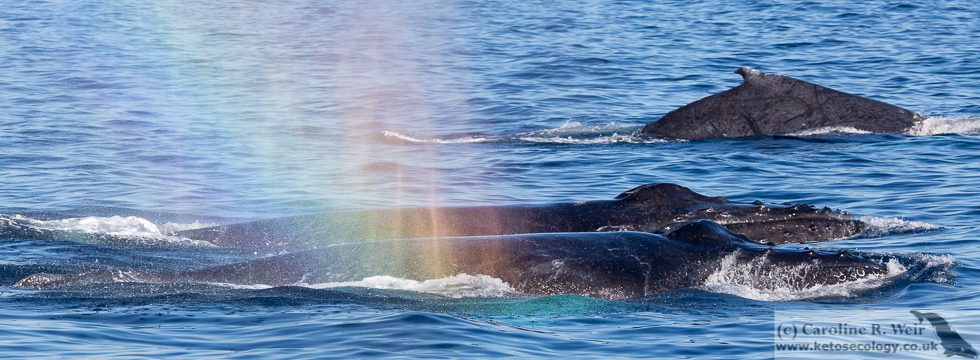
and we head towards it to investigate. Even at this range I can see
the broad back and stubby dorsal profile of a large humpback whale, but the
animal is behaving a little oddly. It surfaces a lot more often than
most of the whales we have been watching this week and seems 'sluggish' at
the surface, sometimes lingering there without even blowing. I am
curious to take a closer look. As we approach to within 100 m of the
whale I have a surprise when a second adult surfaces alongside the first
animal, rolling over on its back to wave its long flippers in the air.
This animal appears far more energetic and spends much greater time below
the water, only surfacing once for every 7 or 8 times that we observe the
first whale.
As the pair continue to travel steadily southwards, I try to take
photographs of their dorsal fins and tail flukes for potentially matching
with the catalogues of identifiable individuals maintained for the region.
As the first whale sounds, I notice a series of cuts along the dorsal
surface of its tailstock close to the flukes. The laceration closest
to the flukes looks rather deep, and these wounds may well explain the
erratic, cumbersome surfacing behaviour exhibited by the whale. It is
sad to think of this whale 'limping' its way on the long journey to it's
Antarctic feeding grounds".
|
|
15 October
2009:
Survey vessel,
Gabon
16:05 GMT
"I
have been battling seasickness for several hours now, but when the chief
officer phones my cabin to tell me that there are whales ahead of us I am
instantly (albeit temporarily!) cured! Ahead of the ship a large area
of disturbed white water makes it easy to pinpoint the location of the
whales, but I am surprised to see around seven individuals in this group.
They are travelling as a very tight-knit group and are surging purposefully
through the water lifting their rostrums clear of the sea and powerfully
blowing. This looks very much like a competitive group of (presumed)
male humpback whales, the individual animals jostling with
each other in the water. As we approach the whales, the sound of their
powerful exhalations carries on the wind and I have to protect my camera
lens from the water droplets produced in their misty blows.
These whales are not shy, and as we drift close by they turn several times
to appear off our stern before travelling up the port side and diving under
the bow. At close range it is possible to see that the skin on the
series of lumpy 'tubercles' on their heads has been broken and is red raw,
presumably from scraping against one another as they interact. Several
times individual animals twist onto their sides to lift their flippers and
tail flukes clear of the water, or lurch through the waves lifting their
heads out. I wonder what is going on subsurface...whether this is
indeed a group of males competing for access to females, or whether I am
misreading some other context. Either way, the sight of such a large
and active group of humpbacks is a great start to the trip".
|
|
25 July
2009:
Research boat,
Stonehaven, Scotland
09:11 GMT
"The
sea is calm today and we are 5 miles off Stonehaven out in the North Sea and
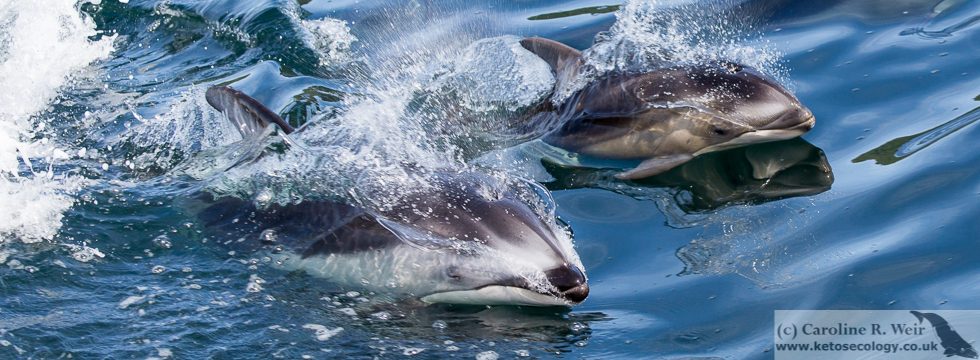
surrounded by numerous feeding gulls, auks and gannets. And all around
us, the tall dark dorsal fins of white-beaked dolphins break the surface.
The dolphins are spread out over several kilometres in small sub-groups, and
some of the groups seem to consist entirely of mother-calf pairs. We
are watching one such group of three adult-calf pairs at the moment.
The calves are tiny - one still has very marked foetal folds and a dorsal
fin that flops slightly to one side, and it has to surface for air much more
regularly than its mother. All of the calves cling to the sides of
their mothers, rising an in inexperienced awkward manner from the water to
take a breath as their mother's smoothly roll at the surface. Although
these calves are small, they are certainly not lacking in confidence.
The adult dolphins approach our research boat at speed, the calves swimming
tightly by their sides, and suddenly the water is bright with white patches
as the dolphins swim underneath our boat and take up position in front of
the bow-wave. They roll slightly on their sides to peer up at the boat
as they pass, their distinctive white eye patches glowing in the water.
The adults position themselves between the boat and their calves, but this
is the only indication of any unease about bringing their newborns to visit
us. The dolphins quickly bore of bow-riding, but when we stop the boat
and drift slowly in the area they return to inspect us, making high-speed
passes underneath the boat and around the stern. At one stage they
seem curious about the propellers, spending a few minutes circling
immediately behind the boat. I wish I had a hydrophone with me, as it
would be interesting to hear if they were firing echolocation clicks at the
boat to investigate. Suddenly they move away, and when white-beaked
dolphins move at speed then it is almost impossible to catch them - they
surface rapidly and keep low in the water, producing a distinctive
rooster-tail of spray and then moving long distances under the water.
It has been a very pleasing encounter, and the research team are all smiles
as we pack away our cameras".
More images from this encounter can be viewed
here.
|
|
13 July
2009:
Whale-watch
boat, Húsavík,
Iceland
09:53 GMT
"Ahead
of the boat a series of tall, bushy blows in front of the snow-capped
mountain range announce the presence of another humpback whale.
Húsavík is probably the best place to see this species in Icelandic waters,
with the regular occurrence of feeding whales in the western part of the bay
many of which are identified by the boat operators year after year.
The animal we are watching at the moment is a medium-sized humpback and is
actively feeding amongst an aggregation of seabirds including puffins,
Arctic terns and fulmars. The whale is spending relatively little time
at the surface, regularly lifting it's tail and diving after only a single
blow. A large V-shaped chunk is missing from the trailing edge of it's
right hand tail fluke, and the whale is also missing the entire right edge
of the fluke. Consequently it is a particularly distinctive individual
which our tour guide proudly announces to be 'Fred', a whale that has been
known to visit the bay for several years now.
'Fred' continues to feed throughout the encounter, sometimes travelling
quite long distances during the dives but usually re-appearing within a few
hundred metres of where it last sounded. Feeding is clearly good in
Húsavík bay, though I am slightly disappointed that the blue whales that
have been present here over the last few weeks have apparently moved out
into deeper water. When I look at the photographs later, a series of
tooth rake marks are also apparent on the underside of Fred's tail fluke, no
doubt the result of an interaction with killer whales on some earlier
occasion. In some areas of the North Pacific it has been shown that
26% of humpback whales have flukes bearing tooth rake marks from killer
whales, and agonistic encounters between these two species are clearly
common in some regions".
|
|
3 May
2009: Chanonry Point, Moray Firth, Scotland
17:49 GMT
"Chanonry
Point is probably the best place in the UK for getting regular close views
of dolphins. The spit extends out into the narrow channel of the inner
Moray Firth, creating strong tidal rips where salmon congregate. Never
slow to take advantage of an easy meal, the local bottlenose dolphin
community is well aware of this excellent feeding potential and congregate
off the point an hour or two prior to high tide when the tidal rips are
strongest. Today, there are round six dolphins feeding off the point,
including a mother and calf pair and several other adults. The
mother-calf pair are tightly associated and surface repeatedly around 10 m
off the point where the adult is enjoying considerable success at catching
fish. Almost every time she surfaces, her mouth is open revealing the
flesh of some unlucky salmon caught between the rows of her conical teeth.
Further out, the adult dolphins are cooperating to herd fish in more open
water, diving repeatedly to reveal their tail stocks and then herding fish
in towards each other. Occasionally this technique results in frenzied
fish chases, the water being churned up into frothy white by the dolphins
manoeuvring just below the surface. The dolphins are not as aerially
active today as I have seen them on other occasions in the past, but we are still
treated to some of the characteristic high bottlenose leaps, with animals
powering themselves vertically from the water and re-entering head first in
a clean arc. The 15 or so people bravely standing at the point in the
chilly wind cheer in response to every leap".
|
|
16 March
2009: Walvis Bay, Namibia
13:28 GMT
"We have
been told a group of around 20 dolphins has stranded alive in the
lagoon, and as we finally drive around a bend in the road and see them I
am shocked at the scene ahead. Out in the middle of the lagoon are
a scattered pod of large dolphins, some on their sides thrashing the
shallow water with their tails and others lying quietly on their
bellies. People have already arrived and most of the animals are
accompanied by at least one human carer.
As we park the
car and move out over the sand towards the dolphins, it becomes clear that
this will be no easy mission. The sand quickly changes into a thick
slimy mud more than knee-deep in places - not the sort of habitat you want
to carry cameras and other equipment! Furthermore, the dolphins are
quickly identifiable as bottlenose dolphins - one of the largest dolphin
species and with adults measuring around 3.5 m and potentially weighing up
to 500 kg! As we near the animals I can hear a multitude of
high-pitched whistles - the piercing tonal cries of distressed dolphins
which are highly audible in the air all around. The regular sharp
exhalations of the dolphins also breaks the silence. It looks like we
will be here for some time, since the high tide is not due for another 6 hr
and even at its highest the water depth here is only a metre or so. I
concentrate firstly on collecting some data - dolphins off Namibia are
rather poorly studied but the
Namibian Dolphin Project established a
photo-identification catalogue of identifiable bottlenose dolphins last year
and they are keen to know which individuals are present here. I wade
carefully through the mud around the stranded animals and try to obtain a
clear photograph of the left and right sides of the dorsal fins. The
nicks, notches and scars on the fins will allow us to match the dolphins to
the animals in the existing catalogue. It's no easy task...time and
time again the camera gets misted by the exhalations of the dolphins blown
towards me on the wind, and several times I have to move quickly out of the
way of thrashing tails. The mud itself makes manoeuvring around the
animals very difficult, and its a slow and tedious process to document all
19 individuals.
 |
 |
Moving around
the dolphins I notice that most of the whistling is actually coming from one
group of animals - a pair of large adults and three small calves including
one very young animal. The calves whistle loudly and continuously,
slapping their tailstocks vigorously and clearly in distress. No-one
knows which adults the calves belong with, since they were stranded
separately and moved to the nearest adults. Quite possibly one of the
adults further up the lagoon which never stops thrashing throughout the
stranding was the mother of one of them. Unfortunately, the youngest
calf suddenly stopped breathing after an hour or two, and could not be
saved.
Once I finish
collecting the photo-identification data, I go and sit with a dolphin and do
my best to keep it's skin moist and stop it from burning in the wind and
sun. We also dig out the mud from under their bellies and flippers to make
them more comfortable. Otherwise, it is a waiting game for the tide.
The initial enthusiasm of the human volunteers begins to wane after a few
hours, as people begin to get cold and the water shows no signs of rising.
Some of the dolphins are suspiciously quiet, and its hard to imagine what
kind of strain they must be under in this unfamiliar predicament. Some
thoughtful people wade through the mud to distribute flasks of coffee and
baskets of sandwiches which is a definite moment of relief for everyone
sitting in the water!"
Several hours
later the tide finally rose sufficiently for the dolphins to be manoeuvred
into slightly deeper water. Once their bellies were clear of the mud
the dolphins moved themselves, propelling themselves through the shallow
water with powerful thrusts of their tails and re-grouping into their
preferred social units. Most of the animals found their way out of the
lagoon and were not seen again during the subsequent days. One adult
re-stranded overnight and had to be taken by vehicle to a suitable release
beach in Walvis Bay the next day where it swam away strongly.
|
|
5 March
2009: Walvis Bay, Namibia, research boat
11:33 GMT
"There
are dolphins galore here today...almost everywhere we look small pods of
Heaviside's dolphins are leaping and splashing as they feed amongst
flocks of terns. We have already spent over an hour approaching
small groups to photograph their dorsal fins, and still there are many
more dolphins spread out ahead of us. Most of the animals are busy
foraging and don't pay much attention to our boat, but the occasional
small group break away from their feeding and swim rapidly towards us to
bow-ride at the front of the boat. At the moment we have a group
of around 10 dolphins playing around the boat - this is the most
interactive group we have encountered today and they seem content to
surf the swell waves alongside the boat for a prolonged duration,
sometimes rushing ahead to ride the bow-wave.
The sharp exhalations of surfacing dolphins are all
around us.
One or two
dolphins swim immediately next to the engine propellers, appearing almost
stationary in the water as they keep level with the boat's slow speed.
Others get bored with the sedate pace and swim rapidly away in a wide loop
to race back to the bow again with seemingly endless energy".
|
|
4 March
2009: Walvis Bay, Namibia, research boat
11:09 GMT
"The
boat operators here have been reporting leatherback turtle sightings in
the centre of the bay, with several sightings per day during the calm
weather in the morning before the afternoon wind picks up. We are
out in the centre of the bay where most of the sightings have occurred,
and it is not long before the large head and distinctive dorsal ridges
of a leatherback roll at the surface. This is a big animal, and
with the engine off we can clearly hear the sharp exhalation of its
breath as it breathes at the surface between dives. Not much
further on, and two more leatherbacks appear at the surface ahead of our
boat. Unlike the previous turtle, these ones seem to be resting at
the surface and we edge the boat forwards to try and get a closer look.
One of the leatherbacks allows us to
approach to within a couple of metres before taking a final breath,
raising its flippers and diving down into the murky water and out of
sight".
|
|
3 March
2009: Walvis Bay, Namibia, research boat
09:10 GMT
"This
morning we have been tracking the same group of bottlenose dolphins that
we were watching yesterday in the lagoon, and they are once again
showing how adept they are at hunting in the shallows. This time
they are close in off a sandy beach, feeding close to a group of
fishermen who are beach seining. The dolphins seem to take
advantage of the human fishing operation, giving the fishermen a lesson
in catching fish as they chase fish into the shallows and trap them
against the beach.
Today the
dolphins are feeding individually rather than herding the fish
cooperatively, but the scene is still impressive as some individuals almost
strand on the beach in pursuit of their prey".
|
|
2 March
2009: Walvis Bay, Namibia, research boat
11:17 GMT
"A group
of five bottlenose dolphins are patrolling the lagoon, entering water
shallower than 1 m depth in their efforts to locate and herd fish.
As we watch, the dolphins circle a shoal of fish and then drive it
rapidly in towards the narrow beach, almost stranding themselves as they
manoeuvre in the shallows. The fish erupt into the air in an
attempt to escape both the dolphins and the beach, and the dorsal fins
of the dolphins turn in rapid circles at the surface as the animals
chase the fish and then move back out into slightly deeper water.
We watch the
group for several hours, and they repeatedly perform this same coordinated
hunting behaviour, rushing in towards the shore with fish flying out of the
water ahead of them. Bottlenose dolphins never fail to produce
something fascinating for us to look at!".
|
|
2 March
2009: Walvis Bay, Namibia, research boat
08:33 GMT
"The
dolphins are in a playful mood this morning - a small group of
Heaviside's dolphins charge through the grey swell to greet our boat,
and spend several minutes bursting out of the water in fast surges on
either side of us. It's practically impossible to photograph them
when they are behaving so unpredictably, and the overcast sky doesn't
help since we can't track the animals as they move along underwater due
to the dark sea.
Despite the
overcast conditions the beautiful markings on
the dolphins show up clearly - the pale grey forward portion of the dolphins
stands out against the sharply-demarcated darker grey-black cape that
extends over the rear part of their bodies. The dolphins also raise
their heads out of the waves during some surfacings to reveal their small,
indistinct beaks and conical heads. Although the encounter is brief it
is memorable for the energy these small dolphins have".
|
|
1 March
2009: Walvis Bay, Namibia, research
boat
09:02 GMT
"A
group of feeding terns catches my eye off our port bow, and as I scan
the area with binoculars a long back and small stubby dorsal fin roll
slowly at the surface underneath them. A humpback whale is
travelling beneath the birds, although we can't determine whether the
whale is actually feeding or not. It is an unusual time of year
for a humpback to be present in this region, as most should be further
south on the feeding grounds at present. The whale itself also
looks unusual - it is rather small and its back and sides are covered in
small white scars.
We take the opportunity to approach the animal to photograph it's dorsal fin
and strange flank markings. The whale isn't fluking so we aren't able
to get images of the tail flukes which might help to match the whale to
existing catalogues for West Africa to determine where it originates from.
But the animal is certainly distinctive enough to be recognised again
without too much trouble".
|
|
1 March
2009: Walvis Bay, Namibia, research
boat
07:09 GMT
"If
I didn't know better I would think I was in the North Sea on a summers
day watching harbour porpoises. But although they look slightly
similar, the small cetaceans I am watching are not porpoises - they are
Heaviside's dolphins, with their distinctive tall triangular fins and
marked colouration pattern. The two dolphins are apparently
foraging in the glassy seas, with dives of several minutes interspersed
with several quick rolls at the surface.
They are mostly indifferent towards our research boat today, obviously too
busy searching for food to come and bow-ride. So we concentrate on
getting usable photo-identification images of their dorsal fins for adding
to the
Namibian Dolphin project catalogue".
|
Return
to the top of the page
Ketos
Ecology ©
2010
|