|


| |
|
Some
of our field notes from the 2007 field season are archived here:
|
19 December
2007: Montserrat, Caribbean
"We are busy completing the paperwork at the handover
between observation shifts, when I happen to look up and see eight boobies
circling and diving into the water off our port bow. Something must be
there! We concentrate on scanning the water below the seabirds, and
suddenly see spray and falcate dorsal fins cutting through the swell.
Dolphins! And they peel away from feeding to swim subsurface towards
the ship, their grey shapes clearly visible in the bright blue Caribbean
water. I radio the acoustic laboratory to inform them of the dolphins, and
then sprint to the ship's bow to try and identify which species we have.
When I reach the bow, I look over to see a small pod of
dolphins circling in the bow-wave, twisting and turning in the waves and
leaping out of the back of the swell. The dolphins are clearly
identifiable as Pantropical spotted dolphins, although the spotting is
almost invisible on these animals. Still the dark dorsal capes, small
dorsal fins and white-lips and beak tips are collectively conclusive as this
species. Unfortunately, the slow speed of our vessel is insufficient
to keep the dolphins occupied for long, and they quickly peel away and
disappear astern of us".
|
November/December
2007: South Africa cetacean trips
Images of southern right whales in Walker Bay
and Heaviside's dolphins in Lambert's Bay can be viewed
here. These encounters were from a range of commercial
cetacean-watching vessels operating in South Africa.
|
6 November
2007: Equatorial Guinea,
Seismic survey vessel
"The seas here contain
more marine litter than I have seen anywhere else in the world. The water
column is full of plastic, and in some places where the tide and oceanic
currents meet the ocean just seems full of plastic bags and other debris. I
am watching one such area of water filled with rubbish this morning, when my
eye is caught by a small shape moving next to some plastic and discarded
fishing net. It is a tiny turtle, and I am saddened to see that its hind
flipper is caught up in the floating plastic litter. I watch as the little
animal thrashes helplessly at the surface, unable to do anything other than
drift along with its plastic prison. But worse is to come. As I am
photographing the juvenile turtle, my colleague alerts me to the presence of
two large turtles thirty metres away. And these animals are also heavily
entangled in a piece of discarded fishing net. We watch as the animals
(both olive ridley turtles) lift their heads above the water to take breaths
of air, in between their struggles.
There is no chance for
these turtles to survive in this situation, but we can do nothing except
watch them drift helplessly past us and away astern of the ship. Only 40
min later, and yet another piece of fishing net passes by, this time
containing two olive ridley turtles and a single green turtle. All
three
animals are alive and thrashing weakly at the surface in a vain attempt for
freedom, and it looks like there are other, dead turtles in the net below
them. It is extremely sad to see no less than six endangered turtles caught in
fishing net in the course of a single morning and be unable to save a
single one. All that I can do is photograph the animals,
write a report on the incident and hope that the
images will raise awareness of the dangers of plastic and fishing net
floating in the oceans".
|
23 October
2007: Equatorial Guinea,
Seismic survey vessel
"We had almost given up
on the dolphins, when finally a few individuals turn and start to swim
towards the ship. We have been tracking this group of dolphins for over 30
min as they ambled around ahead of us, seemingly uncertain of which
direction to go in. Every time we start to draw closer to them, they move
just a bit further away! Finally the frustration is over, as the first
dolphins arrive at the front of the ship and turn to play in the bow-wave.
The hourglass pattern
on their sides makes them easily recognisable as common dolphins, although
we are not sure whether these animals are the long- or the short-beaked
species. They twist and turn in the waves below us, and we can hear loud
whistles from the animals as they communicate with each other. Our vessel
is travelling too slowly to be too much fun for the dolphins, and most of
them peel off and head away after only a few minutes. But three animals
persevere for a while longer, clearly finding the ship better entertainment
than anything else the tropical waters can offer!"
|
15
August
2007: Congo, Seismic survey
vessel
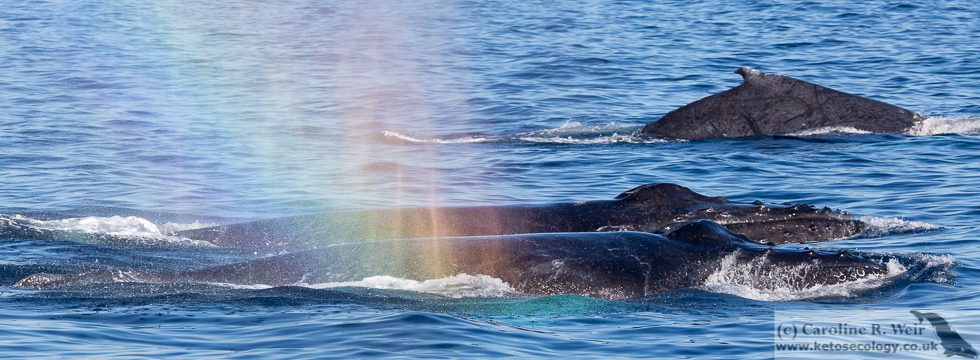
"A loud blow sounds
close by, audible even over the loud background drone of the engines. I
peer over the railings and see the smooth, wide back of a humpback whale, a
mere 20 m off the bow of the vessel. With a further loud exhalation a
second animal surfaces beside it. I had seen the tall, bushy blows of
humpback whales ahead of the ship 15 min ago, but did not expect that they
would surface so close. The whales seem very aware of our approaching ship,
and move calmly but purposefully out of our way with a sequence of steady
surfacings and bushy blows. Their progress can be easily traced by the oil
slick ‘footprints’ that appear at the surface, from each swipe of their
enormous tail flukes as they move forwards through the water. Finally, they
lift their tails into the air and disappear off our port side".
|
August
2007: The Minch, west Scotland,
research vessel
During August we carried out field work in the
Minch, located off the west coast of Scotland. The survey encountered
many groups of common and white-beaked dolphins. The results of this
survey can be viewed
here, and a
selection of images from the project are available
here.
|
June 16 to July
28
2007: Angola, Southern Africa, Seismic survey vessel
Please
visit our
June/July
Diary
page for details and photographs of the highlights from a cetacean/turtle survey off
Angola during June and July 2007. This survey produced a high
diversity of dolphin species, including rough-toothed dolphins, Fraser's
dolphins, false killer whales, humpback whales and sperm whales.
|
|
Jun 9
2007: Research survey vessel, Aberdeen, North-east
Scotland
Images of bottlenose dolphins
encountered during a photo-identification survey off Aberdeen on 9th
June:
|
|
Jun 8
2007: Research survey vessel, Aberdeen, North-east
Scotland
Images of bottlenose dolphins
encountered during a photo-identification survey off Aberdeen on 8th
June:
|
|
Jun 1
2007: Research survey vessel, Aberdeen, North-east
Scotland
Images of bottlenose dolphins
encountered during a photo-identification survey off Aberdeen on 1st
June:
|
|
May
25
2007: Research survey vessel, Aberdeen, North-east
Scotland
Images of bottlenose dolphins
encountered during a photo-identification survey off Aberdeen:
|
May
3-18
2007: Angola, Southern Africa, Seismic survey vessel
Please
visit our
May
Diary
page for details of the highlights from a short survey off Angola during
May 2007.
|
|
April 26
2007: Research survey vessel, Aberdeen, North-east
Scotland
Logbook 10:26 UTC
"A few hundred metres ahead of the boat a sleek back and the tall,
falcate dorsal fin of a dolphin emerges from the calm, grey North
Sea. The dolphin surfaces a couple more times as I am en route
to the wheelhouse to note the time and position. Through the window,
the dolphin looks large and robust and although I don't really get a
good look at it, there is something about it's profile and sedate
behaviour does not quite fit the mould of the more typical
bottlenose dolphins that we often encounter here off Aberdeenshire.
We stop the boat and drift for a while but the dolphin does not
reappear. Unsure what I have just observed, I record the
animal rather unsatisfactorily as 'large dolphin sp' and am
busy filling in the data sheet when the vessel suddenly slows down.
I look ahead just in time to see the slicky 'footprints' from two
animals that have clearly just sounded close to the front of the
boat. Brian, our skipper, emerges from the wheelhouse and I
can tell from his excitement that these are not the usual bottlenose
dolphins. I already suspected the first animal may have been a
Risso's dolphin, and I consequently ask Brian about the size and
colouration of the animals he just saw. His response, 'larger
and paler than bottlenoses' pretty much agrees with my suspicion and
we turn the boat round and try to re-sight them. Far ahead of
us an animal is half-leaping from the water, creating large
splashes. Presumably another individual dolphin, and I
estimate at least four or five animals in total. But they are
spread out in one's and two's and in typical Risso's fashion they
are quite elusive, surfacing sporadically and travelling large
distances on their subsurface dives. We finally catch up with
one pair, and transit parallel to them around 400 m away. This
pair are very white in colour, exhibiting lots of scarring and with
very white bulbous heads. The first animal had appeared a much
more darker grey colour. We track the 'white pair', and each
individual is easily identified by their respective markings.
One adult has a large white irregular-shaped scar on its upper left
flank, forward of the fin. It's companion has a thick
horizontal linear scar across the upper left side of the dorsal fin.
|
 |
|
 |
|
 |
|
 |
The animals surface several times
and then sound, reappearing some time later. I am so busy
concentrating on photographing them that I almost miss another
dolphin surface a few metres off the side of the boat. It's
sharp exhalation registers with me only a few seconds later and I
lower my camera in time to see it's fin disappearing beneath the
water. A pale oblong moving along subsurface informs me of the
animal's location, and I focus on the ghostly shape ready to take a
photo-identification 'mug-shot'. This animal has a large nick
missing from the lower trailing edge of it's fin, and should be easy
to re-identify. Again the dolphins disappear, and we travel
along for several minutes without any sign of them. Then, a
fin appears a few hundred metres off our port side and we try to
catch up with the animal. It is moving more quickly, and
heading slightly offshore away from the cliffs. On one
surfacing it lifts it's head quite high from the water in a
head-slap, and I am able to glimpse the large white scar on its back
that identifies it as one of the previous pair. It's companion
has completely disappeared from view. I am surprised how far
these dolphins are moving below the water between surfacing, and how
inconspicuous they are even in this calm sea. In light of
their elusive behaviour we decide to leave them to their travels,
and we turn north again to resume our bottlenose dolphin survey".
|
 |
|
 |
Although this species has been
reported from shore on rare occasions, this was the first record of
Risso's dolphins from our research vessel in eight years of
surveying this coastline and is the first time that
photo-identification shots have been taken of Risso's dolphins off
the Aberdeenshire coast.
|
|
April 18
2007: Aberdeen Harbour, Aberdeen, North-east
Scotland
Logbook 12:52 UTC
"Bottlenose dolphins are frequent visitors to Aberdeen Harbour.
In fact, at certain times of the year they are present much more
than they are absent, spending many hours daily feeding in and
around the breakwaters. The dolphins have been here every day
this week, and I am currently watching at least 18 animals foraging.
There are two deformed youngsters here that are easily recognisable
from shore, plus a number of adults. Occasionally individual
animals enter the navigation channel and forage around the Old South
Breakwater providing closer range opportunities for
photo-identification work. However, they are still too far
away to identify any but the most well-marked of individuals. One
such animal is 'Trekky', an adult bottlenose with a distinctive
large nick out of the top trailing edge of his fin and another nick
near the bottom. Trekky repeatedly enters the confines of the
navigation channel and circles slowly around, presumably foraging
for salmonids. However, he is quick to leave when vessels
approach to enter or leave the harbour. In fact the dolphins
are remarkably tolerant of the numerous traffic moving through their
feeding ground, and today alone there have been tankers, a ferry,
lifeboats, survey vessels, pilot boats, supply boats and fishing
boats. The dolphins largely ignore the various vessels, simply
moving out of their way and returning again once they have left".
|
 |
|
 |
Later that week on the 24th April the
dolphins are in a boisterous post-feeding mood, and several animals
repeatedly approach and bow-ride the vessels entering the harbour!
|
|
April 6
2007: Research survey vessel, Aberdeen, North-east
Scotland
Logbook 10:41 UTC
"Dolphins!
After almost three hours of searching we see splashes and the
characteristic rolls of dorsal fins ahead of our boat. The
dolphins are heading north towards us, and at speed. The
nearest fins are about 600 m off the cliffs, but more animals are
passing close to the cliff and there are even more further behind
the leading group. This spread out assemblage of bottlenose
dolphins is not keen on inter-acting with our boat, and we fail to
get within even 100 m of an animal for more than a few seconds.
Disappointed, we make no attempt to follow but instead continue on
our survey southwards.
Ten minutes later we spot more dolphins porpoising our way.
This group appears more compact and is certainly more approachable in
nature, so we turn the boat around and travel north alongside them for a
while. There are around six dolphins in the group, and they surface
steadily close to the cliff edge. There are at least three animals in
this group that I recognise from our 2006 surveys. Hubbs and Paperclip
(named by the
CRRU)
travel closely together, accompanied by a mother and calf.
Unfortunately, this small calf shows signs of a spinal deformity, its back
clearly distorted and bulging behind its dorsal fin. This is a similar
deformity to the juvenile we monitored last year (see
here), and that juvenile's mother Sophie, is also travelling with this
group. The long-term prognosis for these deformed animals is unknown,
but is not promising. We photograph the group for several minutes and
I watch the calf surface several times in between Hubbs and Paperclip, as if
being protected by the two males.
Shortly, I become
aware that several more dolphins are rushing from the south to catch
up with us. And clearly visible amongst
this new group is Cutter, a very recognisable dolphin with a huge
chunk missing out of the front of her dorsal fin almost certainly
caused by a propellor collision. As she surfaces alongside us,
a smaller paler shape appears by her side . . . a calf.
Cutter's calf stays very close to it's mother, surfacing in
synchrony as if attached by glue. We are saddened to notice
that this calf too looks slightly abnormal. There is a
distinct bulge on its back to the front of the dorsal fin, and this
looks like yet another spinal deformity. Despite this, the
calf is keeping up well with its boisterous mother, and they
overtake our boat with ease and chase after the other dolphins.
We are thrilled to have caught up with Cutter and
some other dolphins we recognise, although the spinal problems with
the youngsters is definitely a worry. This North Sea
population of dolphins is geographically isolated from other
bottlenose dolphins, and the frequency with which spinal deformities
are occurring amongst the calves would certainly seem to be a
concern for the long-term viability of the population".
|
February-March
2007: Angola, Southern Africa, Seismic survey vessel
Please
visit our
February/March
Diary
page for details of the highlights and field notes from survey work
carried out in Angola during early 2007, including encounters with sperm whales, dolphins and turtles.
|
Return
to the top of the page
Ketos
Ecology ©
2008
|