2005 Archive

Back
2009 Archive
2008 Archive
2007 Archive
2006 Archive
2005 Archive
2004 Archive
2003 Archive


Some of our field notes from the 2005 field season are archived here:


August-September 2005:  Angola, Southern Africa, Seismic survey vessel

Please visit our September Angola Diary page for details of the many highlights and field notes from survey work carried out in Angola during August and September, including humpback whales, Kogia whales, dolphins and turtles.


7th July 2005:  West of Barra, Hebrides, Scotland, research vessel

Logbook 14:04 UTC

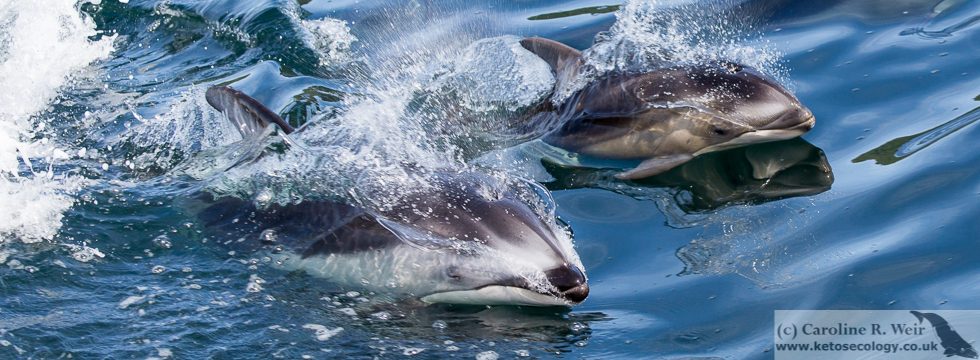
" The gannets give them away - almost a hundred white specks circling in the sky ahead of us.  We are so positive that there will be dolphins underneath the birds, that we radio down to the lab to prepare everyone for forthcoming action!  We are pleasantly surprised to see dorsal fins cutting through the water towards our approaching ship.  We had been expecting these animals to most likely be Atlantic white-sided dolphins, a species that largely avoids vessels.  However instead we watch the dolphins pick up speed and start porpoising rapidly towards our ship - these are 'vessel-friendly' common dolphins and they break off from their feeding to visit us with excited leaps.  The dolphins are not too impressed with the bow-wave and don't stay there long.  But they seem to find endless amusement in the stern wake, repeatedly leaping exuberantly along the port side much to the excitement of the crew who are watching and photographing them from all around the ship.  It is hard to know who is having the most fun, dolphins or people!".  


3rd July 2005:  Rockall Trough, Scotland, research vessel

Logbook 08:35 UTC

"Not a good day for cetacean spotting!  In fact, not a good day for anything!  Although it is July and there is a heat wave on the UK mainland, out here in the Rockall Trough summer has its own rules.  And today that means a Force 11 wind whipping up a 10 m swell.  After a quick trip out on the deck in the morning to take photographs of the angry Atlantic Ocean, I spend the remainder of the day reading in my bunk - the only place on the ship where I do not fall over!"


29th June 2005:  Stanton Bank, Barra, Scotland, research vessel

Logbook 05:35 UTC

"Dawn is always a mixed blessing at sea.  It can be the most spectacular time of the day when the sky is clear and the sun rises in an area good for cetaceans.  Alternatively it can be something of a nightmare when raining and cold, or when one has had only a few hours sleep from the previous day's watch.  This morning we began watch at 4:30 am and few words have been exchanged as we regularly fill in the data log and consume large quantities of caffeine in an attempt to fully waken up.  I however, am quietly optimistic - this region around Barra Head in the Outer Hebrides is a haunt of my favourite dolphin species, the white-beaked dolphin.  And I am determined to find them . . . ! 


Sometimes it is not a question of us finding the dolphins, but more of them finding us!  Staring for over an hour at the steady rise and fall of the grey sea, I get quite a shock when three large dolphins surface only 300 m ahead of us clearly coming close to explore the ship.  We quickly note down the time and position of the vessel, by which time the dolphins have decided to wake us up with a vigorous display of leaping . . . or at least as vigorous as white-beaked dolphins get!  For this is a relatively large and robust species, and not as graceful and agile as many other dolphins.  Instead, they leap from the water almost vertically before falling back onto their sides and backs with a large splash!  One slightly smaller individual leaps repeatedly for several minutes as it moves away from the vessel, a commendable performance that has us laughing and applauding by the time it has finished!" 


28th June 2005:  Sound of Sleat, Isle of Skye, Scotland, research vessel

Logbook 15:55 UTC

"The Isle of Skye is bathed in bright June sunlight as we sail out beneath the spectacular Skye Bridge and out towards The Minch.  Almost everyone is already on deck, fully expecting to find an array of cetaceans before supper.  With five pairs of eyes all attentively scanning the sea surface, it is not long before we spot the circling seabirds ahead of the ship.  Feeding seabirds are an excellent cue for locating cetaceans, and the types of birds present can also provide clues about what to expect.  Many of our dolphin sightings in this region are accompanied by flocks of circling and plunge-diving gannets.  However these birds did not show the diagnostic long stiff wings and black wing tips of Northern Gannets.  Instead we observe the smaller shapes of kittiwakes and auks, with a few larger black-backed gulls.  As we watch the kittiwakes suddenly lift together from the water, and a shout goes up almost simultaneously varying from "There!", to "Thing!" to "Whale!" to "Minke!" depending on each persons experience!  The sloped back of the whale rolls beneath the birds, and its paler chevron colouration is clearly visible in the sunlight.  We watch the minke whale surface several further times before disappearing on another feeding dive.  Our bird 'spys' resume hovering ahead, clearly expectant of more feeding when the whale returns again to the surface!"


16th June 2005:  Bay of Biscay, ferry survey

Logbook 08:03 UTC

"I have rarely observed such mirror calm seas in the Bay of Biscay, a region notorious for its stormy weather!  The conditions are absolutely perfect for spotting cetaceans, and we are also over ideal habitat - transiting southwards across the continental slope towards Santander in Spain, where the water depth decreases from over 4,000 m to less than 100 m.  Several graceful Cory's shearwaters fly past, their images perfectly reflected in the glassy sea surface.  There are only a handful of people up on deck this early, including a few hardy souls with binoculars accompanying me in the search for cetaceans.  We are not disappointed.  Standing out against the background of the flat grey sea, a dark shape catches my eye about 2 km from the ship.  I quickly focus my binoculars on the area, and immediately recognise the outline of a small whale - a long, sloped back with a relatively small and triangular dorsal fin.  The whale surfaces again, this time with a second animal, and I can see clearly their defined sloped foreheads and paler head colouration from which I am able to identify the animals as Cuvier's beaked whales.  We are lucky - the animals surface repeatedly in a small area, changing direction twice and providing good (if distant!) views of their profile.  I even have time to pick up my camera and take a few pictures!  If only the weather were this calm on every Biscay crossing . . . !"


8th June 2005:  Pembrokeshire, West Wales, research vessel

Logbook 10:47 UTC

"About 1 km ahead of us appear more splashes.  Yet more dolphins, and these ones are heading our way and at speed!  Common dolphins are rather excitable animals and seem to enjoy nothing better than greeting vessels for bow- and wake-riding.  These animals mill around ahead of us for a while before finally turning and porpoising rapidly to the vessel's bow with long agile leaps from the water.

Trying to accurately count dolphins when they are porpoising rapidly in groups is difficult, but we estimate about 30 animals in this school.  It takes only seconds for the dolphins to arrive at the ship, where upon they perform U-turns in the water and begin to ride the vessel's bow.  Other dolphins travel alongside the ship, and some play in the stern wave astern of us.  We have no idea how long the dolphins will remain with the vessel, so the team immediately begins the task of documenting the animals and photographing the dorsal fins to try and locate nicks and scars that might allow the same individuals to be re-identified in the future.  Some of the dolphins have strangely-shaped dorsal fins (see individual on the left hand side of the photograph below) and others have the entire tops of their fins missing.  How this damage was caused we can't know, but unfortunately it possibly results from interactions with vessels.

We are even privileged enough to witness the dolphins mating as they swim alongside the ship.  Two individuals repeatedly roll on to their backs clearly revealing their white bellies below the water surface (photo below).  The mating continues for at least the 20 minutes that we are watching the dolphins, and it is interesting that this group clearly continued their natural behaviour even when interacting with the survey vessel for a prolonged period".


March-May 2005:  Angola, Southern Africa, Seismic survey vessel

Please visit our May Angola Diary page for many highlights and field notes from survey work in Angola during March, April and May.


28th January 2005:  Angola, Southern Africa, Seismic survey vessel

Logbook 11:15 UTC

I have been watching this group of dolphins since they first became visible as occasional distant dots on the horizon.  Now, as they draw nearer to the vessel, I can see there are several hundred animals milling at the surface.  It looks very much as though they are waiting for our vessel to draw near - some of the 'keener' individuals jump high into the air in twisting athletic leaps, as if to encourage the more reserved dolphins in the group!  Finally, the nearest animals can wait no longer, and together they turn towards the vessel and porpoise excitedly to the bow - over 300 Atlantic spotted dolphins!  

These first animals seem to cue the remaining group, and for the next half an hour we have dolphins all around the vessel - bow-riding, playing around the towed paravanes and leaping alongside.  Some animals are even waiting ahead of us - I can see their dorsal fins logging at the surface as they listen to the approaching ship before calmly lifting their tails high into the air 30 m ahead of us and appearing leisurely on the bow-wave.  We can hear their high-pitched whistles as animals communicate to one another, and we watch a mother-calf pair surfacing together amongst the bedlam of the other dolphins.  

Several of the animals have the small round pink wounds typical from cookie-cutter shark attacks.  At one point I see an apparently aggressive interaction - one dolphin opening its mouth and lunging at another individual as if to warn it off the bow.  Presumably there is a dominance hierarchy here, but the water in the mouth of the Congo River is a turbid yellow colour and it is difficult to track particular individuals for any length of time.  Eventually the dolphins have all taken a turn on the bow, and the last few peel away and disappear towards the main group which can now be seen several kilometers astern of us leaping and breaching away". 


8th January 2005:  Angola, Southern Africa, Seismic survey vessel

Logbook 09:37 UTC

I have never been so close to sperm whales before - we are sitting in a small 7 m boat in deep water off Angola, surrounded by an estimated 18-20 sperm whales.  The bumpy calluses on their dorsal fins confirm my expectation that this is a group comprising mostly adult females.  I am grateful for this fact - adult males are a third larger again, and these 10 m females already seemed massive from the close, sea-level perspective offered from our rather exposed small boat!  I glance back at the seismic vessel which is 5 km astern of us - I first observed these whales about an hour previously and had been tracking them from the seismic ship when a large amount of splashing and blood-filled spray caught my attention.  Immediately I understood what I was witnessing, and the crew agreed to launch the small boat and take me over to the action.  Only now that we are sitting here amongst the sperm whales, I am beginning to feel a little vulnerable!   Because ourselves and the sperm whales are not alone . . . 

Suddenly, we simultaneously hear and see them - the explosive blows and striking black and white colouration of five killer whales!  The killers spy-hop and half-breach excitedly out of the water, a display of behaviour which I am sure the sperm whales must find as intimidating as I do.  In response, the sperm whales huddle tighter together and seem to include us in their defensive cluster - although we try to stay on the outside of the sperm whale group, the whales repeatedly move closer to us as if seeking shelter around our tiny boat. 

Throughout the 20 min that we spend with the whales, the killer whales remain ahead of the sperm whale group and disappear on quite long sub-surface dives before reappearing with the excited active behaviour seen previously.  It is almost as though they are taunting the sperm whales, harrassing them and waiting for them to tire.  The sperm whales stay together in a large tightly-packed mass of wrinked backs and low, bushy blows.  Occasionally a whale lifts its head clear of the water, and emits rapid click trains that are clearly audible to us on the boat.  Some of the sperm whales appear to semi-charge the killer whales - moving purposefully together towards the killers.  In fact, I note that the sperm whales stay orientated towards the killer whales throughout the encounter, never allowing them to move astern even though the massive powerful flukes of the sperm whales must offer a good defense.  

Unfortunately, time is against me and we soon have to return to the seismic vessel where our small boat is required for a crew change.  Such are the drawbacks of working on an industrial vessel rather than a dedicated research ship!  Nevertheless, I am immensely thankful for the opportunity to observe for a short time this rare interaction at such close range - attacks by killer whales upon sperm whales have rarely been seen at sea, but are known to sometimes last for 5 or 6 hours.  Perhaps these killer whales were waiting for further recruits to assist in making a kill - five killer whales alone is possibly not sufficient to try and take on an entire pod of sperm whales.  Or maybe this 'stand-off' continued until the killers tired and abandoned the sperm whales unharmed.  I will never know the outcome of the interaction, but encountering these two impressive predators close-up was an experience I shall never forget.

MORE IMAGES FROM THIS ENCOUNTER CAN BE VIEWED HERE.


Return to the top of the page

Ketos Ecology © 2006